- Home
-
- Newborns (0-3 months)Your essential guide to navigating the beautiful chaos of life with a newborn. Get expert-backed, practical advice for: • Feeding Fundamentals – breastfeeding/bottle troubleshooting • Sleep Secrets – safe sleep practices & pattern decoding • Soothing Techniques – colic relief to swaddling tricks • Developmental Milestones – what to expect each week • Parent Survival Tips – self-care for exhausted caregivers
- Infants ( 4 -12 months)Your go-to resource for navigating the exciting first year of discoveries! This section provides expert guidance on: • Milestone Development – rolling, sitting, crawling to first steps • Feeding Transitions – introducing solids, allergy awareness • Sleep Patterns – establishing healthy routines • Safety Proofing – mobile baby essentials • Bonding Activities – play that supports growth “From wobbly first sits to messy food adventures – we’ve got your back through every ‘first’!” Shorter Version: “The Infant Playbook: Decoding babbling, surviving teething, and celebrating each new skill – your month-by-month guide to baby’s first year.”
- Toddlers (1-3 years)Your survival guide for parenting’s most energetic (and exhausting) phase! Get battle-tested strategies for: • Communication Breakthroughs – From first words to mini-debates • Taming Tantrums – Meltdown prevention and response • Play That Teaches – Turning daily chaos into learning moments • Safety 101 – Childproofing for tiny escape artists • Routine Magic – Making meals/naps/bedtime actually happen “Where ‘no’ becomes their favorite word, and your patience gets Olympic-level training!” Shorter Version: “Toddlerhood Unlocked: Navigating picky eating, potty training, and endless curiosity with science-backed sanity savers.” Key Tools Include: ✓ Developmental milestone tracker ✓ Power struggle diffusers ✓ Islamic manners introduction ✓ Transition tricks (Pacifier to potty)
- Preschoolers (3-5 years)Your essential toolkit for nurturing curious minds and growing independence! This section helps you: • Spark Early Learning – Fun literacy/numeracy activities • Navigate Big Emotions – Emotional regulation tools • Build Social Skills – Sharing, making friends, conflict resolution • Establish Routines – Morning/bedtime success strategies • Parenting Wins – Positive discipline that works “Where ‘why?’ becomes their favorite word, and every day brings new discoveries!” Shorter Version: “Preschool Power: Turn playtime into learning time while navigating this magical (and messy) stage of endless questions and growing independence.” Featured Resources: ✓ School readiness checklists ✓ Islamic manner builders ✓ Creative discipline techniques ✓ Developmental milestone guides
- School-Age (6-12 years)This golden age of childhood blends growing independence with lingering sweetness, as kids develop crucial academic and social skills while still valuing family connections. Our resources help you navigate homework battles, friendship dramas, and first crushes while preserving that precious parent-child bond. You’ll find practical strategies to boost confidence, instill responsibility, and handle the unique challenges of these transformative years – from managing screen time to preparing for puberty’s first changes. Whether facing school anxiety, social conflicts, or just the daily juggle of activities, we provide the tools to raise resilient, well-rounded kids during this pivotal stage.
- Teenagers (13-18 years)The rollercoaster years of self-discovery! This section helps parents navigate the delicate balance between giving wings and maintaining roots. Get expert-backed strategies for: • Communication Without Conflict – Talking with, not at, your teen • Digital World Navigation – Social media, gaming, and online safety • Academic Pressure Cooker – Managing exams and future planning • Islamic Identity – Keeping faith relevant in their evolving world
- Young Adults (18+ years)Your continued parenting playbook for when “children” become independent adults. This section offers guidance on: • The New Adult Relationship – Shifting from authority figure to trusted advisor • Life Launch Support – Career, marriage, and financial independence • Islamic Identity Reinforcement – Keeping faith central in their autonomous decisions • Digital Age Challenges – Navigating adult responsibilities in connected world
- Newborns (0-3 months)
-
- Teens & TweensNavigate the challenging adolescent years with expert-backed guidance tailored for modern Muslim families. This section offers practical strategies for communicating with eye-rolling teens, managing screen time battles, and supporting emotional development – all while maintaining Islamic values. Discover how to transform conflicts into connections, set boundaries with love, and prepare your tween/teen for adulthood through our culturally-relevant resources, real parent stories, and psychologist-approved approaches to everything from social media use to university preparation.
- Emotional GrowthHelp your child develop emotional intelligence and resilience with expert-guided strategies. This section provides age-appropriate tools to nurture self-awareness, healthy expression of feelings, and positive coping mechanisms – building a strong psychological foundation for life. Key Features: ✓ Emotion identification exercises ✓ Anxiety/stress management techniques ✓ Social skills development ✓ Parent-child bonding activities Alternative Version: “Growing Little Hearts: Your guide to raising emotionally intelligent children who can understand, express, and manage their feelings in healthy ways.” Focus Areas: Building self-esteem Managing big emotions Developing empathy Overcoming setbacks
- Health & SafetyYour trusted resource for keeping children healthy and protected at every age. Get evidence-based guidance on nutrition, illness prevention, home safety, and emergency preparedness – all presented in clear, actionable steps for busy parents. From baby-proofing checklists to handling teen mental health concerns, we translate medical expertise into practical parenting solutions. Shorter Alternative: “Childproof your parenting knowledge! Quick-access health guidelines and safety must-knows from pediatric experts – because growing kids need protection at every stage.” Key Features: ✓ Age-specific health milestones ✓ Safety certification standards ✓ First aid visual guides ✓ Pandemic-era protocols
- Learning & PlayTransform everyday moments into powerful learning opportunities! This section reveals how play builds cognitive skills, creativity, and problem-solving abilities through: • Age-appropriate play guides (0-12 years) • DIY educational toys from household items • STEAM activities disguised as fun • Cultural/Islamic play ideas “Where laughter and learning meet – because children grow smarter when they’re having fun!” Shorter Version: “Play With Purpose: Discover how to turn splashy baths into science lessons and block towers into math skills – the magic of learning through play!” Key Benefits: ✓ Develops critical thinking ✓ Enhances language skills ✓ Promotes Islamic values ✓ Adaptable for all abilities
- Parenting Self-CareYou can’t pour from an empty cup. This essential section reminds caregivers that nurturing yourself isn’t selfish – it’s survival. Discover practical ways to recharge your patience and energy through: • 5-Minute Recharge Tricks for exhausted parents • Guided Relaxation adapted for chaotic households • Emotional First Aid for parenting burnout • Partner Support Strategies to share the load
- Humor & Relief**7. Humor & Parenting Relief** Parenthood is tough – laugh your way through it! This section delivers the comic relief every parent needs, featuring hilarious parenting memes, relatable “mom fail” stories, and laugh-out-loud kid quotes that turn daily chaos into comedy gold. Discover why 93% of parents say humor is their #1 coping strategy through our: • **”They Actually Said That!”** collection of unbelievable kid logic • **Parenting meme library** for when you need to laugh instead of cry • **”Guess What My Kid Did”** anonymous confessions • **Comic strips** about those universal parenting moments *”Because sometimes the only way to survive toddler tantrums is through shared laughter!”* **Shorter Version:** “Parenting humor that gets you through the day – where spilled milk becomes comedy material and toddler tantrums turn into tomorrow’s funny story!”
- Sleep & RoutinesHelp your child (and yourself!) get the rest you need with science-backed sleep solutions and daily rhythm strategies. Discover how to: • Create calming bedtime rituals • Solve common sleep challenges • Design daily routines that reduce stress • Adapt schedules as children grow “Because well-rested families are happier families!” Shorter Version: “From bedtime battles to morning routines – reclaim your family’s rhythm with sleep solutions that actually work.” Key Features: ✓ Age-specific sleep guides ✓ Sample routine templates ✓ Gentle sleep training methods ✓ Cultural/Islamic adaptations
- Tantrums & BehaviorYour practical guide to navigating challenging behaviors with confidence and compassion. Discover effective, research-backed strategies to: • Prevent meltdowns before they start • Respond calmly to tantrums • Teach emotional regulation skills • Set loving boundaries that stick “Turning tough parenting moments into growth opportunities!” Shorter Version: “From tantrums to time-outs – decode behavior challenges and respond in ways that actually work.” What You’ll Find: ✓ Age-by-age behavior guides ✓ Positive discipline techniques ✓ Islamic parenting perspectives ✓ Real parent success stories
- Teens & Tweens
-
- 4. Child Development**4. Child Development** Your trusted resource for understanding and supporting your child’s growth journey—from first steps to adolescence. Get science-backed guidance on cognitive, emotional, physical, and social development at every age and stage. **Key Features:** ✓ **Milestone Trackers:** Know what to expect from newborns to teens ✓ **Learning Boosters:** Brain-building play ideas for each developmental phase ✓ **Behavior Decoded:** Understand the “why” behind challenging behaviors ✓ **Special Needs Support:** Inclusive strategies for all children ✓ **Parent Tools:** Turn everyday moments into growth opportunities *Backed by child psychologists and educators—because every child deserves to thrive.* 🌱 **Shorter Alternative:** **”Child Development”** Master your child’s growth journey with age-specific guides—from baby milestones to teen brain development. Science-made-simple for parents!
- 3. Family & Relationships**3. Family & Relationships** Your essential guide to stronger marriages, happier parenting, and healthier family connections – practical wisdom for modern relationships. **Or the shorter version:** **Family & Relationships** Love smarter, parent wiser, and build unbreakable bonds – research-backed advice for thriving relationships. **Or more specific:** **Family & Relationships** From date nights to parenting fights, we help you: ✓ Communicate better ✓ Resolve conflicts ✓ Balance work/family ✓ Keep love alive
- 2.Parenting & Childraising**Parenting & Childraising** A dedicated category providing parents and caregivers with expert advice, practical tips, and trusted resources for raising happy, healthy children. Covers all stages from newborns to teens, including child development, positive discipline, educational activities, and solutions for common parenting challenges. Whether you’re a first-time parent or an experienced caregiver, find guidance to nurture your child’s physical, emotional, and cognitive growth with confidence. *Topics include: parenting techniques – child psychology – learning through play – handling behavioral issues – health & nutrition for kids* 👶🧸
- 1. Education & Teaching### **Education & Teaching** This category focuses on enhancing the learning and teaching experience by providing educators, students, and parents with valuable resources, strategies, and tools. It covers modern teaching methods, curriculum development, e-learning technologies, and classroom management techniques. Whether you’re a teacher looking to improve your skills, a student seeking effective study strategies, or a parent supporting your child’s education, this category offers insights to foster academic growth and innovation. *Examples: Teacher training, educational technology, lesson planning, student engagement techniques.* 🎓📚
- 4. Child Development
- Blogs
- About
- Contact Us

20 Powerful Activities to Build Language Skills in Children
20 Fun Activities to Develop Language Skills in Children (Expert-Backed)
Language is the foundation of learning, social interaction, and emotional expression. It shapes how children understand the world, connect with others, and express their needs and ideas. From the first coos and babbles to full sentences, language development is closely tied to daily experiences, not formal instruction.
During early childhood—especially between ages 0 and 5—the brain shows exceptional neuroplasticity, meaning it rapidly forms connections in response to repeated, meaningful language input. Every conversation, gesture, and shared activity strengthens these neural pathways. This is why everyday moments often have a greater impact than structured lessons.
Importantly, language development does not depend on expensive toys, flashcards, or apps. Children learn best through interactive, responsive exchanges with familiar adults. Simple actions—like naming objects, responding to a child’s attempt to communicate, or expanding on their words—create a powerful learning environment when repeated consistently.
Many parents worry about “doing it right” or following a strict method. In reality, effective language support is flexible and adapts to the child’s level. A toddler who uses single words benefits from modeling and repetition, while a preschooler thrives when encouraged to explain, predict, or tell stories. The key is matching interaction to the child’s current abilities.
Another important factor is emotional safety. Children are more likely to experiment with sounds and words when they feel heard and understood. Pressure, correction, or constant testing can reduce motivation to communicate. Play-based activities lower this pressure and make language practice feel natural rather than forced.
This guide focuses on screen-free, evidence-informed activities commonly used or recommended by speech-language professionals. Each activity is designed to fit easily into daily routines, whether at home, outdoors, or during playtime. No prior expertise is required—only attention, patience, and consistency.
The activities also acknowledge real-life family dynamics. They work for:
- Busy parents with limited time
- Children with varying language levels
- Monolingual and bilingual households
Rather than targeting isolated skills, these activities support language development holistically—combining vocabulary growth, listening skills, expressive language, and social communication. When practiced regularly, even for a few minutes a day, they can make a meaningful difference.
By the end of this section, you’ll have a clear understanding of how intentional play and everyday interaction can support strong language foundations—without stress, screens, or complexity.
Why Early Language Development Matters
Chart: Relative Benefit of Language Activities
This chart shows the most effective activities for developing children’s language skills.
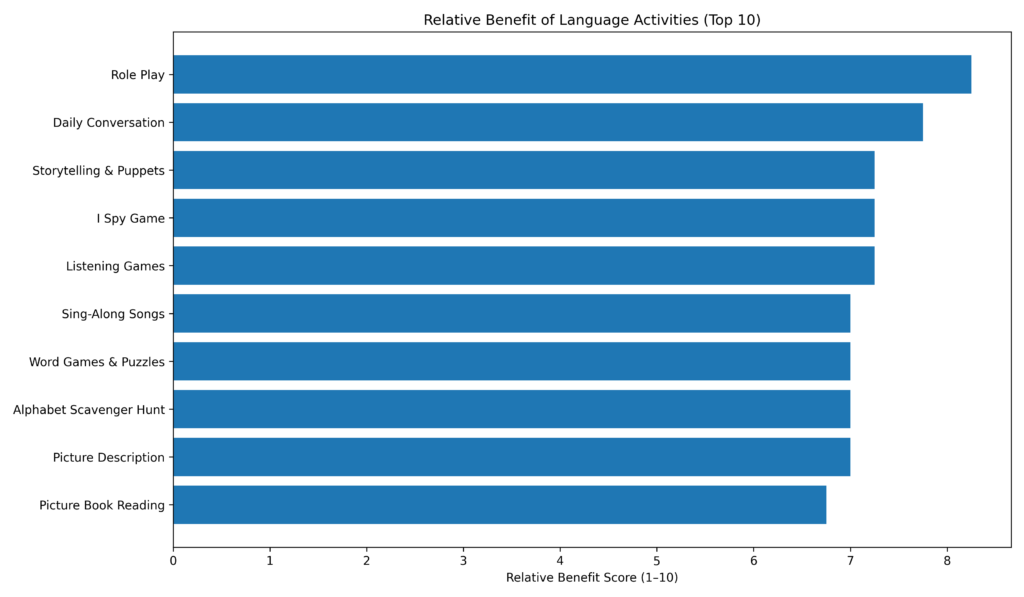
The first five years of life are often called the critical period for language development. During this window, children rapidly build:
- Vocabulary
- Listening (receptive language)
- Speaking (expressive language)
- Social communication skills
Children who receive rich, responsive language input early tend to develop stronger reading, writing, and academic skills later on. Early support also helps reduce frustration in children with speech delay.
20 Engaging Language Development Activities
Comprehensive Table (20 Activities)
| Activity Type | Primary Language Skill Developed | Recommended Age Range | Quick Example / How to Do It |
|---|---|---|---|
| Role Play | Conversation & Vocabulary | 3–8 years | Pretend to be a shopkeeper, doctor, or teacher |
| Storytelling with Puppets | Narrative Skills & Expressive Language | 3–7 years | Use puppets to act out a story |
| Picture Book Reading | Listening Comprehension & Vocabulary | 0–5 years | Ask questions about the pictures |
| Sing-Along Songs | Pronunciation & Phonological Awareness | 2–6 years | Sing nursery rhymes together |
| Rhymes & Fingerplays | Rhythm & Phonemic Awareness | 1–4 years | “Itsy Bitsy Spider” with finger motions |
| Word Games (Scrabble, Boggle) | Vocabulary & Spelling | 6–10 years | Find words from letters in a timer |
| Alphabet Scavenger Hunt | Letter Recognition & Phonics | 2–5 years | Find objects that start with each letter |
| Sensory Play (Playdough, Sand) | Descriptive Language & Vocabulary | 2–7 years | Describe texture, color, shape |
| “I Spy” Game | Observation & Vocabulary Expansion | 3–7 years | “I spy something blue…” |
| Labeling Household Items | Word Recognition & Vocabulary | 2–5 years | Label objects with sticky notes |
| Daily Conversation Time | Conversation Skills & Listening | 2–10 years | Ask open-ended questions daily |
| Story Retelling | Memory & Narrative Structure | 4–8 years | Child retells the story in their words |
| Picture Description | Descriptive Language & Sentence Building | 3–8 years | Describe what’s happening in a picture |
| Word Matching (Flashcards) | Vocabulary & Word Recognition | 3–6 years | Match word to picture |
| Puppet Interview | Questioning & Answering Skills | 4–8 years | Child “interviews” a puppet or parent |
| Cooking Together | Sequencing & Vocabulary | 3–9 years | Follow a recipe step-by-step |
| Show and Tell | Public Speaking & Confidence | 4–8 years | Child presents a toy or object |
| Daily Journal (Draw + Write) | Writing & Expression | 5–10 years | Draw and write 1–2 sentences daily |
| Listening Games (Simon Says) | Listening Comprehension | 3–7 years | Follow instructions carefully |
| Story Cubes (Dice Storytelling) | Creativity & Sentence Building | 5–10 years | Roll dice and create a story |
This collection of activities is designed to target multiple aspects of language development through play, interaction, and daily routines. Each activity can be adjusted to match your child’s age and current communication level, making them suitable for both early talkers and children who need extra support.
The focus is not on perfection or performance, but on exposure, repetition, and meaningful interaction. Even brief, consistent practice—5 to 10 minutes at a time—can support steady progress when embedded naturally into the day.
Below, each activity builds on a slightly different skill set, such as vocabulary growth, sentence structure, listening, or social communication. Parents can choose a few favorites and rotate them to keep interactions fresh and engaging.
1. Interactive Reading & Dialogic Storytelling (The Gold Standard)
This approach turns reading into a conversation rather than a one-way activity. The adult pauses, responds, and encourages the child to participate actively instead of passively listening.
The technique is especially effective when the same book is read multiple times, allowing the child to anticipate words and gradually contribute more language with each reading.
2. The “Mystery Bag” Sensory Game
This activity strengthens the connection between sensory input and descriptive language. Children learn to translate physical sensations into words, which supports later storytelling and explanation skills.
It is particularly helpful for children who benefit from hands-on learning or who struggle to describe objects they cannot immediately see.
3. Narrating Your Day (Sports Casting)
By verbalizing routine actions, adults provide clear language models without requiring a response from the child. This reduces pressure while still delivering rich input.
Over time, children begin to imitate familiar phrases or complete predictable sentences, especially during repeated routines.
Pretend conversations help children practice conversational structure in a low-stakes setting. The predictability of greetings and responses supports confidence and fluency.
This activity also introduces pragmatic language skills, such as knowing when to speak, pause, or respond appropriately.
5. Choice-Based Questions
Offering choices creates a natural reason for the child to use words. Unlike yes/no questions, it gently prompts verbal output without forcing full sentences.
This strategy is particularly effective during meals, dressing, or playtime when decisions occur naturally.
6. Sing Songs with Actions
Music paired with movement supports memory and sequencing. Repetitive lyrics help children anticipate words, making participation easier over time.
Songs also model rhythm and intonation, which are key components of clear speech.
7. Sound Imitation Games
Imitating sounds lays the groundwork for later word production. It allows children to experiment with mouth movements in a playful way.
These games are especially useful for children who are not yet using words consistently.
8. Picture Naming Walk
This activity links real-world objects to language in context. Naming items while walking provides constant opportunities for vocabulary exposure.
Pausing after labeling gives the child space to attempt words without pressure.
9. “What’s Missing?” Game
This game supports memory, attention, and expressive language. Children must recall and name an absent object rather than simply identify what is present.
It can be easily adapted by increasing or decreasing the number of objects used.
10. Daily Routine Talk
Predictable routines help children understand sequence and cause-effect language. Repeated phrases become familiar and easier to imitate.
This consistency supports comprehension before expressive language emerges.
11. Sorting & Categorizing
Grouping objects helps children learn how words relate conceptually. It builds early logic skills alongside vocabulary.
This activity also introduces descriptive language such as size, color, and function.
12. Puppet Conversations
Using puppets creates emotional distance, which often makes speaking feel safer for hesitant children.
The puppet can “ask” questions or make mistakes, prompting the child to respond naturally.
13. Emotion Labeling
Naming emotions gives children language for internal experiences. This supports both communication and emotional regulation.
Real-life moments make these words more meaningful and easier to remember.
14. Outdoor Language Games
Outdoor environments offer rich auditory and visual input. Games like “I Spy” sharpen listening and descriptive skills simultaneously.
Movement also helps some children stay engaged longer.
15. Repetition with Variation
Repeating phrases with small changes reinforces sentence structure without sounding robotic.
This technique helps children notice patterns in language and apply them flexibly.
16. Turn-Taking Games
Turn-taking teaches the rhythm of conversation. Waiting, responding, and listening are all practiced naturally through play.
These skills transfer directly to real conversations.
17. Pretend Store
Role-play scenarios introduce functional language used in everyday interactions, such as requesting and responding.
They also encourage longer utterances as children explain choices or needs.
18. Story Sequencing Cards
Sequencing activities support narrative skills by teaching logical order.
They prepare children for more complex storytelling and early literacy tasks.
19. Bilingual Labeling (If Applicable)
Using both languages in natural contexts supports understanding without confusion.
Children learn to associate meaning across languages through consistent exposure.
20. Screen-Free Replacement Activities
Short, intentional activities can replace passive screen time without overwhelming parents or children.
Even brief interactions can provide richer language input than hours of passive media.
These activities work best when chosen based on your child’s interests and repeated consistently over time. The goal is not to complete all 20, but to integrate a few into everyday life in a way that feels natural and enjoyable for both parent and child.
Activities for Different Age Groups
Toddlers (1–3 Years)
- Sound imitation
- Choice-based questions
- Interactive reading with pictures
Preschoolers (3–5 Years)
- Storytelling
- Role-play games
- Emotion-based conversations
The Role of “Serve and Return” Interaction
Language grows when parents respond to a child’s attempts to communicate.
- Child points → Parent names
- Child vocalizes → Parent responds
This back-and-forth builds neural connections essential for speech.
Common Language Development Myths
- “Bilingualism causes confusion” → ❌ False
- “Late talkers are lazy” → ❌ False
- “Screens teach language” → ❌ False
Children learn language from people, not devices.
When to Consult a Speech-Language Pathologist (SLP)
Seek professional advice if your child:
- Uses no words by 18 months
- Has limited understanding of language
- Loses previously learned words
- Rarely attempts communication
Early support leads to better long-term outcomes.
Conclusion & Final Tips for Parents
Language development doesn’t require perfection—just consistency. Short, meaningful interactions throughout the day are more powerful than long sessions. Celebrate every attempt, respond warmly, and remember: progress looks different for every child.
FAQ Section (Schema-Ready)
How can I help my 2-year-old develop language skills?
Use daily routines, interactive reading, and choice-based questions.
What are the four stages of language development?
Pre-linguistic, single words, word combinations, and sentence formation.
Does screen time affect language development?
Yes, excessive passive screen use can delay expressive language.
Are these activities suitable for speech delay?
Yes, they are commonly recommended by SLPs for early support.
Can bilingual children learn language normally?
Absolutely. Bilingual exposure supports cognitive flexibility.