- Home
-
- Newborns (0-3 months)Your essential guide to navigating the beautiful chaos of life with a newborn. Get expert-backed, practical advice for: • Feeding Fundamentals – breastfeeding/bottle troubleshooting • Sleep Secrets – safe sleep practices & pattern decoding • Soothing Techniques – colic relief to swaddling tricks • Developmental Milestones – what to expect each week • Parent Survival Tips – self-care for exhausted caregivers
- Infants ( 4 -12 months)Your go-to resource for navigating the exciting first year of discoveries! This section provides expert guidance on: • Milestone Development – rolling, sitting, crawling to first steps • Feeding Transitions – introducing solids, allergy awareness • Sleep Patterns – establishing healthy routines • Safety Proofing – mobile baby essentials • Bonding Activities – play that supports growth “From wobbly first sits to messy food adventures – we’ve got your back through every ‘first’!” Shorter Version: “The Infant Playbook: Decoding babbling, surviving teething, and celebrating each new skill – your month-by-month guide to baby’s first year.”
- Toddlers (1-3 years)Your survival guide for parenting’s most energetic (and exhausting) phase! Get battle-tested strategies for: • Communication Breakthroughs – From first words to mini-debates • Taming Tantrums – Meltdown prevention and response • Play That Teaches – Turning daily chaos into learning moments • Safety 101 – Childproofing for tiny escape artists • Routine Magic – Making meals/naps/bedtime actually happen “Where ‘no’ becomes their favorite word, and your patience gets Olympic-level training!” Shorter Version: “Toddlerhood Unlocked: Navigating picky eating, potty training, and endless curiosity with science-backed sanity savers.” Key Tools Include: ✓ Developmental milestone tracker ✓ Power struggle diffusers ✓ Islamic manners introduction ✓ Transition tricks (Pacifier to potty)
- Preschoolers (3-5 years)Your essential toolkit for nurturing curious minds and growing independence! This section helps you: • Spark Early Learning – Fun literacy/numeracy activities • Navigate Big Emotions – Emotional regulation tools • Build Social Skills – Sharing, making friends, conflict resolution • Establish Routines – Morning/bedtime success strategies • Parenting Wins – Positive discipline that works “Where ‘why?’ becomes their favorite word, and every day brings new discoveries!” Shorter Version: “Preschool Power: Turn playtime into learning time while navigating this magical (and messy) stage of endless questions and growing independence.” Featured Resources: ✓ School readiness checklists ✓ Islamic manner builders ✓ Creative discipline techniques ✓ Developmental milestone guides
- School-Age (6-12 years)This golden age of childhood blends growing independence with lingering sweetness, as kids develop crucial academic and social skills while still valuing family connections. Our resources help you navigate homework battles, friendship dramas, and first crushes while preserving that precious parent-child bond. You’ll find practical strategies to boost confidence, instill responsibility, and handle the unique challenges of these transformative years – from managing screen time to preparing for puberty’s first changes. Whether facing school anxiety, social conflicts, or just the daily juggle of activities, we provide the tools to raise resilient, well-rounded kids during this pivotal stage.
- Teenagers (13-18 years)The rollercoaster years of self-discovery! This section helps parents navigate the delicate balance between giving wings and maintaining roots. Get expert-backed strategies for: • Communication Without Conflict – Talking with, not at, your teen • Digital World Navigation – Social media, gaming, and online safety • Academic Pressure Cooker – Managing exams and future planning • Islamic Identity – Keeping faith relevant in their evolving world
- Young Adults (18+ years)Your continued parenting playbook for when “children” become independent adults. This section offers guidance on: • The New Adult Relationship – Shifting from authority figure to trusted advisor • Life Launch Support – Career, marriage, and financial independence • Islamic Identity Reinforcement – Keeping faith central in their autonomous decisions • Digital Age Challenges – Navigating adult responsibilities in connected world
- Newborns (0-3 months)
-
- Teens & TweensNavigate the challenging adolescent years with expert-backed guidance tailored for modern Muslim families. This section offers practical strategies for communicating with eye-rolling teens, managing screen time battles, and supporting emotional development – all while maintaining Islamic values. Discover how to transform conflicts into connections, set boundaries with love, and prepare your tween/teen for adulthood through our culturally-relevant resources, real parent stories, and psychologist-approved approaches to everything from social media use to university preparation.
- Emotional GrowthHelp your child develop emotional intelligence and resilience with expert-guided strategies. This section provides age-appropriate tools to nurture self-awareness, healthy expression of feelings, and positive coping mechanisms – building a strong psychological foundation for life. Key Features: ✓ Emotion identification exercises ✓ Anxiety/stress management techniques ✓ Social skills development ✓ Parent-child bonding activities Alternative Version: “Growing Little Hearts: Your guide to raising emotionally intelligent children who can understand, express, and manage their feelings in healthy ways.” Focus Areas: Building self-esteem Managing big emotions Developing empathy Overcoming setbacks
- Health & SafetyYour trusted resource for keeping children healthy and protected at every age. Get evidence-based guidance on nutrition, illness prevention, home safety, and emergency preparedness – all presented in clear, actionable steps for busy parents. From baby-proofing checklists to handling teen mental health concerns, we translate medical expertise into practical parenting solutions. Shorter Alternative: “Childproof your parenting knowledge! Quick-access health guidelines and safety must-knows from pediatric experts – because growing kids need protection at every stage.” Key Features: ✓ Age-specific health milestones ✓ Safety certification standards ✓ First aid visual guides ✓ Pandemic-era protocols
- Learning & PlayTransform everyday moments into powerful learning opportunities! This section reveals how play builds cognitive skills, creativity, and problem-solving abilities through: • Age-appropriate play guides (0-12 years) • DIY educational toys from household items • STEAM activities disguised as fun • Cultural/Islamic play ideas “Where laughter and learning meet – because children grow smarter when they’re having fun!” Shorter Version: “Play With Purpose: Discover how to turn splashy baths into science lessons and block towers into math skills – the magic of learning through play!” Key Benefits: ✓ Develops critical thinking ✓ Enhances language skills ✓ Promotes Islamic values ✓ Adaptable for all abilities
- Parenting Self-CareYou can’t pour from an empty cup. This essential section reminds caregivers that nurturing yourself isn’t selfish – it’s survival. Discover practical ways to recharge your patience and energy through: • 5-Minute Recharge Tricks for exhausted parents • Guided Relaxation adapted for chaotic households • Emotional First Aid for parenting burnout • Partner Support Strategies to share the load
- Humor & Relief**7. Humor & Parenting Relief** Parenthood is tough – laugh your way through it! This section delivers the comic relief every parent needs, featuring hilarious parenting memes, relatable “mom fail” stories, and laugh-out-loud kid quotes that turn daily chaos into comedy gold. Discover why 93% of parents say humor is their #1 coping strategy through our: • **”They Actually Said That!”** collection of unbelievable kid logic • **Parenting meme library** for when you need to laugh instead of cry • **”Guess What My Kid Did”** anonymous confessions • **Comic strips** about those universal parenting moments *”Because sometimes the only way to survive toddler tantrums is through shared laughter!”* **Shorter Version:** “Parenting humor that gets you through the day – where spilled milk becomes comedy material and toddler tantrums turn into tomorrow’s funny story!”
- Sleep & RoutinesHelp your child (and yourself!) get the rest you need with science-backed sleep solutions and daily rhythm strategies. Discover how to: • Create calming bedtime rituals • Solve common sleep challenges • Design daily routines that reduce stress • Adapt schedules as children grow “Because well-rested families are happier families!” Shorter Version: “From bedtime battles to morning routines – reclaim your family’s rhythm with sleep solutions that actually work.” Key Features: ✓ Age-specific sleep guides ✓ Sample routine templates ✓ Gentle sleep training methods ✓ Cultural/Islamic adaptations
- Tantrums & BehaviorYour practical guide to navigating challenging behaviors with confidence and compassion. Discover effective, research-backed strategies to: • Prevent meltdowns before they start • Respond calmly to tantrums • Teach emotional regulation skills • Set loving boundaries that stick “Turning tough parenting moments into growth opportunities!” Shorter Version: “From tantrums to time-outs – decode behavior challenges and respond in ways that actually work.” What You’ll Find: ✓ Age-by-age behavior guides ✓ Positive discipline techniques ✓ Islamic parenting perspectives ✓ Real parent success stories
- Teens & Tweens
-
- 4. Child Development**4. Child Development** Your trusted resource for understanding and supporting your child’s growth journey—from first steps to adolescence. Get science-backed guidance on cognitive, emotional, physical, and social development at every age and stage. **Key Features:** ✓ **Milestone Trackers:** Know what to expect from newborns to teens ✓ **Learning Boosters:** Brain-building play ideas for each developmental phase ✓ **Behavior Decoded:** Understand the “why” behind challenging behaviors ✓ **Special Needs Support:** Inclusive strategies for all children ✓ **Parent Tools:** Turn everyday moments into growth opportunities *Backed by child psychologists and educators—because every child deserves to thrive.* 🌱 **Shorter Alternative:** **”Child Development”** Master your child’s growth journey with age-specific guides—from baby milestones to teen brain development. Science-made-simple for parents!
- 3. Family & Relationships**3. Family & Relationships** Your essential guide to stronger marriages, happier parenting, and healthier family connections – practical wisdom for modern relationships. **Or the shorter version:** **Family & Relationships** Love smarter, parent wiser, and build unbreakable bonds – research-backed advice for thriving relationships. **Or more specific:** **Family & Relationships** From date nights to parenting fights, we help you: ✓ Communicate better ✓ Resolve conflicts ✓ Balance work/family ✓ Keep love alive
- 2.Parenting & Childraising**Parenting & Childraising** A dedicated category providing parents and caregivers with expert advice, practical tips, and trusted resources for raising happy, healthy children. Covers all stages from newborns to teens, including child development, positive discipline, educational activities, and solutions for common parenting challenges. Whether you’re a first-time parent or an experienced caregiver, find guidance to nurture your child’s physical, emotional, and cognitive growth with confidence. *Topics include: parenting techniques – child psychology – learning through play – handling behavioral issues – health & nutrition for kids* 👶🧸
- 1. Education & Teaching### **Education & Teaching** This category focuses on enhancing the learning and teaching experience by providing educators, students, and parents with valuable resources, strategies, and tools. It covers modern teaching methods, curriculum development, e-learning technologies, and classroom management techniques. Whether you’re a teacher looking to improve your skills, a student seeking effective study strategies, or a parent supporting your child’s education, this category offers insights to foster academic growth and innovation. *Examples: Teacher training, educational technology, lesson planning, student engagement techniques.* 🎓📚
- 4. Child Development
- Blogs
- About
- Contact Us

Why Isn't My Child Talking? 8 Causes + Professional Treatment Plan
Executive Summary
Speech and language delays affect approximately 1 in 5 children under age five, making them among the most common developmental concerns parents face. This comprehensive guide provides evidence-based information to help parents distinguish between typical developmental variation and delays requiring professional attention.
You will learn the critical difference between speech delay (difficulty producing sounds) and language delay (difficulty understanding or using words), recognize age-specific milestones from birth to five years, and identify red flags that warrant pediatric evaluation. The guide addresses common causes including developmental factors (autism spectrum disorder versus isolated speech delay), environmental influences (screen time and social interaction), and medical conditions affecting communication.
Most importantly, this resource offers practical, actionable strategies parents can implement immediately at home, while emphasizing that early intervention—when needed—consistently produces the best outcomes. Whether your child is slightly behind, significantly delayed, or you simply want reassurance, this guide provides clarity without judgment, empowering you to support your child’s communication development with confidence.
Why Is My Child’s Speech Delayed? Causes, Signs, and Proven Solutions
Few concerns cause parents more anxiety than noticing that their child is not talking like other children their age. If you find yourself wondering whether your toddler’s speech development is “normal,” you are not alone—and you are not overreacting.
Speech and language delays are among the most common developmental challenges in early childhood. For many children, these delays are temporary and highly responsive to early support. For others, timely intervention can make a lifelong difference.
This guide is written for parents who want clear answers, medical accuracy, and realistic guidance—without panic or judgment. You will learn what speech delay really means, how to recognize early signs, and what proven steps you can take to support your child’s communication development.
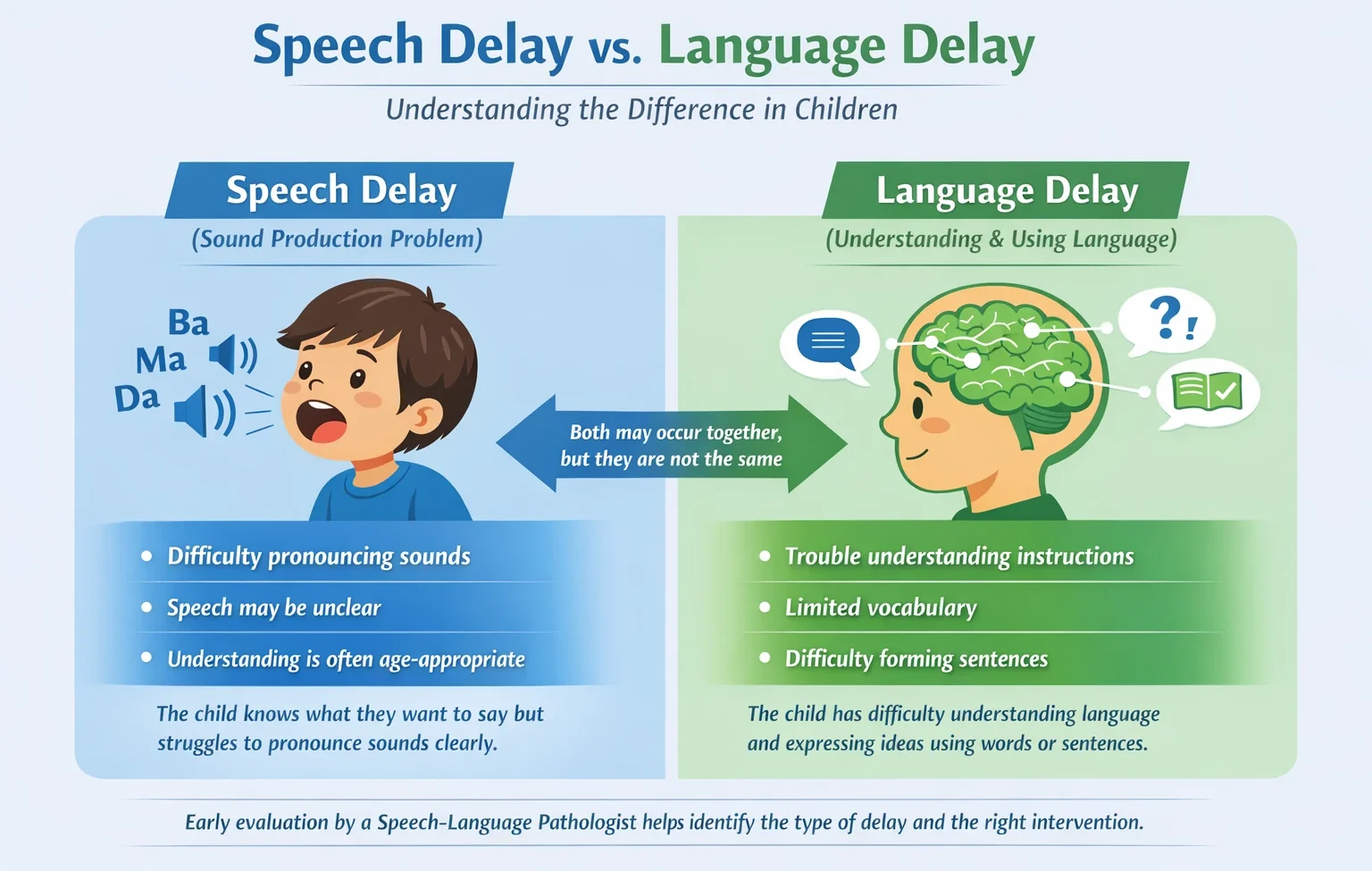
Although the terms are often used interchangeably, speech delay and language delay are not the same. Understanding the difference helps parents better describe their concerns and seek the right type of support.
What Is a Speech Delay?
A speech delay refers to difficulty with the physical production of sounds. A child may:
- Pronounce words unclearly
- Omit or substitute sounds
- Be hard to understand, even to family members
Speech delays are related to how sounds are formed using the lips, tongue, and mouth.
What Is a Language Delay?
A language delay affects a child’s ability to understand or use words meaningfully. It can appear in two main forms:
- Expressive language delay: Difficulty expressing thoughts, needs, or ideas
- Receptive language delay: Difficulty understanding words, questions, or instructions
Some children experience both, while others struggle in only one area.
📌 Important clarification:
A child may understand everything you say but struggle to speak—or speak clearly but not fully understand language. Each pattern requires a different approach.
Every child develops at their own pace, but speech-language professionals rely on developmental ranges to identify when extra support may be helpful. These milestones are not meant to compare children—they are tools to guide early awareness.
Typical Communication Milestones by Age
| Age | Expected Communication Skills |
| 6 months | Babbling, eye contact, response to sound |
| 12 months | 1–5 words, understands simple commands |
| 18 months | 10–20 words, uses gestures |
| 24 months | 50+ words, two-word phrases |
| 3 years | Short sentences, understood by family |
| 4 years | Clear speech, understood by strangers |
| 5 years | Storytelling, correct grammar |
A Closer Look at Communication Milestones by Age
While charts are helpful, real-life development is more nuanced. Below is a deeper look at what speech and language development typically looks like at each stage—and when parents may want to pay closer attention.
🎁 Speech Milestone Tracker (PDF)
Birth to 6 Months: Building the Foundation
Communication begins long before a child says their first word. During this stage, babies learn through sound, facial expressions, and interaction.
Common behaviors include:
- Cooing and early vocal play
- Smiling in response to voices
- Making eye contact during feeding
- Reacting to loud or sudden sounds
🚩 When to monitor closely:
Limited vocalization or little reaction to sound may warrant a hearing screening.
6 to 12 Months: Babbling With Meaning
Babbling becomes more intentional as babies experiment with speech-like sounds.
You may notice:
- Repetitive syllables such as “ba-ba” or “da-da”
- Responding to their name
- Using gestures like pointing or waving
- Understanding simple words like “no”
🚩 Possible concern:
Minimal babbling or lack of response to familiar voices by 9–10 months.
12 to 18 Months: First Words and Intentional Communication
This stage marks the transition from sound play to meaningful language.
Most children begin to:
- Say a few clear words
- Follow simple instructions
- Imitate words they hear
- Use gestures to communicate needs
- A Note for Parents Reading These Milestones
- If you found yourself mentally checking off milestones—or feeling a knot of worry while reading—pause for a moment. Not every missed milestone signals a serious problem, and not every child develops on the same timeline.
- What matters most is patterns over time, not isolated moments. A child who is slowly progressing may simply need more exposure, interaction, or time. However, when progress stalls or multiple milestones are missed, it may be a sign that additional support could be helpful.
- Understanding milestones gives parents clarity—not to compare their child to others, but to recognize when questions are worth asking.
- From Milestones to Action: Knowing When to Look Deeper
- Milestones tell us what typically develops and when.
The next step is understanding which signs suggest a need for professional guidance and which variations are still within a typical range. - In the next section, we’ll explore specific red flags by age—clear indicators that pediatricians and speech-language pathologists use to decide when further evaluation is recommended.
- This knowledge empowers parents to move from uncertainty to confident, informed action.
Red Flags: When to Consult a Pediatrician
While developmental milestones provide helpful guidance, they do not tell the whole story. What truly matters is recognizing when a child’s speech or language development may need professional attention.
Many parents hesitate to raise concerns, hoping their child will “catch up.” In some cases, that happens. In others, waiting can delay valuable support during a critical window of brain development. Knowing the red flags allows parents to act early—without panic, but with confidence.
Speech Delay Red Flags by Age: What Professionals Look For
Speech-language pathologists and pediatricians rely on patterns, not single behaviors. Below are age-specific signs that may indicate the need for further evaluation.
Red Flags by 6 Months
At this stage, communication is primarily nonverbal, but it is already highly interactive.
🚩 Possible concerns include:
- Little or no cooing or vocal play
- Limited eye contact during feeding or interaction
- Rare reactions to sound or voices
- Minimal smiling or social engagement
👉 Why this matters:
Early sound play and social responses form the foundation for later speech. A lack of response may suggest hearing or sensory concerns.
Red Flags by 9–12 Months
By the end of the first year, babies typically become more intentional communicators.
🚩 Watch for:
- No repetitive babbling (such as “ba-ba” or “da-da”)
- Inconsistent response to their name
- Little use of gestures like pointing or waving
- Limited interest in social interaction
📌 Gestures are especially important—they often appear before spoken words and signal readiness for language.
Red Flags by 15–18 Months
This period usually brings a child’s first meaningful words.
🚩 Concerning signs include:
- No spoken words
- Limited understanding of simple instructions
- Rare attempts to imitate sounds or words
- Loss of previously acquired words or gestures
⚠️ Regression is always a red flag and should be discussed with a healthcare provider promptly.
Red Flags by 24 Months
Age two is one of the most critical checkpoints in speech and language development.
🚩 Seek evaluation if:
- Vocabulary is fewer than 50 words
- No two-word combinations (for example, “more milk”)
- Difficulty understanding simple questions
- Limited interest in communicating needs
Many parents search: “Is it normal for a 2-year-old to only say 20 words?”
From a clinical perspective, this milestone deserves closer attention.
Red Flags by 36 Months
By age three, speech should be functional and increasingly clear.
🚩 Potential concerns include:
- Speech that is difficult for family members to understand
- Rare use of short sentences
- Difficulty following two-step directions
- Limited back-and-forth interaction
📥 Download the Doctor Visit Checklist (Printable PDF)
Pediatrician or Speech-Language Pathologist: Who Should You See First?
- Start with a pediatrician if you notice missed milestones, regression, or broader developmental concerns
- Consult a speech-language pathologist (SLP) directly if speech or language difficulties persist or are the primary concern
In many regions, parents can access speech-language pathology services without a referral, allowing for faster support.
Why Early Action Makes a Difference
Decades of research show that children who receive early speech and language support:
- Develop stronger communication skills
- Experience less frustration and fewer behavioral challenges
- Show improved readiness for learning and school
Early evaluation does not mean something is “wrong.”
It means a child is being given the support they need at the right time.
A Gentle Reminder for Parents
Not every child who shows one red flag will have a speech disorder. At the same time, persistent signs should never be ignored out of fear or uncertainty.
Trusting your instincts—and asking questions early—is one of the most powerful things you can do for your child.
🔄 Transition to the Next Section
Red flags help identify when to seek support.
The next step is understanding why speech delays happen in the first place—and how to distinguish between different developmental causes.
In the next section, we’ll explore developmental factors, including one of the most common and sensitive concerns for parents:
the difference between speech delay and autism.
Common Causes of Speech Delay in Children
Developmental Factors – Autism and Global Developmental Delay
When parents first learn that their child may have a speech delay, one question often rises above all others—sometimes quietly, sometimes with fear:
“Could this be autism?”
This concern is understandable. Autism spectrum disorder (ASD) is frequently discussed in relation to speech and language development. However, it’s critical to clarify an important fact early on:
Speech delay alone does not mean autism.
Understanding how developmental factors influence communication can help parents move from fear to informed action.
Autism vs. Speech Delay: Understanding the Difference Without Panic
Autism is a neurodevelopmental condition that affects social communication, behavior, and interaction. While speech delay can be one feature of autism, most children with speech delays do not meet criteria for ASD.
The key difference lies not only in how much a child speaks—but how they communicate and interact socially.
Key Differences Between Speech Delay and Autism Spectrum Disorder
Area of Development | Speech Delay | Autism Spectrum Disorder |
Desire to communicate | Strong, but frustrated | Often reduced or atypical |
Eye contact | Generally appropriate | Limited or inconsistent |
Use of gestures | Common (pointing, waving) | Often limited |
Response to name | Usually consistent | Often inconsistent |
Imitation | Actively imitates sounds/actions | Limited imitation |
Play skills | Pretend play present | Repetitive or restricted |
Social engagement | Enjoys interaction | May prefer solitary play |
Progress over time | Gradual improvement | Skills may plateau or regress |
📌 Clinical insight:
Children with isolated speech delay usually want to communicate but struggle with the mechanics of speech or language. Children with autism often show differences in social communication itself, not just speech output.
Signs That Often Point to Speech Delay (Not Autism)
Children with speech delay—but not autism—commonly:
- Use gestures effectively to communicate needs
- Show strong emotional attachment to caregivers
- Engage in pretend or imaginative play
- Understand far more language than they can express
- Become visibly frustrated when they are not understood
These children are typically socially motivated, even if their speech is limited.
Signs That May Warrant an Autism Evaluation
While only trained professionals can diagnose autism, further evaluation may be recommended when speech delay appears alongside:
- Limited or absent eye contact
- Rare response to name
- Minimal interest in people or social interaction
- Repetitive behaviors (such as hand flapping or lining up toys)
- Strong resistance to changes in routine
- Loss of previously acquired words or social skills
⚠️ Regression is always significant and should be discussed with a healthcare professional promptly.
Global Developmental Delay and Speech
In some cases, speech delay is part of a broader developmental pattern, known as global developmental delay. This may involve delays in:
- Motor skills
- Cognitive development
- Social-emotional skills
- Adaptive functioning
Identifying global delay early allows professionals to create coordinated intervention plans, addressing multiple developmental areas together.
Why Early Screening Is Helpful—No Matter the Outcome
Many parents worry that evaluation will lead to a permanent label. In reality, early screening serves a very different purpose.
Early developmental assessment:
- Clarifies a child’s strengths and needs
- Guides appropriate support strategies
- Improves long-term communication outcomes
- Reduces parental uncertainty and stress
Whether the result is speech delay, autism, or another developmental difference, early support consistently leads to better outcomes.
A Reassuring Perspective for Parents
It’s important to remember that many children who are late to speak go on to develop strong communication skills with the right support. A diagnosis—or lack of one—does not define a child’s future.
The goal of evaluation is not labeling.
The goal is understanding—and supporting development during the brain’s most adaptable years.
🔄 Transition to the Next Section
Developmental factors explain why some children experience speech delays.
Equally important, however, are environmental influences—especially in today’s digital world.
In the next section, we’ll explore how screen time, technology, and social interaction affect speech development, and what current research in 2026 reveals about the so-called “digital nanny” effect.
Common Causes of Speech Delay in Children
Environmental Factors – The Role of Screen Time and Social Interaction
In today’s world, screens are everywhere—phones, tablets, televisions, and even smart toys. For many families, digital media has become part of daily life. As a result, parents often ask an important question:
Can screen time affect my child’s speech development?
Current research suggests that the answer depends less on whether children use screens and more on how those screens are used.
Screen Time and Speech Delay in 2026: What the Research Shows
Recent studies (2025–2026) show a consistent association between excessive passive screen exposure and delays in expressive language development.
Passive screen time typically involves:
- Television or videos playing without interaction
- Background TV during meals or play
- Independent viewing without adult participation
When screens replace conversation, children miss out on essential opportunities to hear, process, and practice language in real time.
Why Human Interaction Matters More Than Content
Language is learned through responsive interaction—the back-and-forth exchange between a child and a caregiver.
This interaction includes:
- Eye contact
- Turn-taking
- Immediate responses
- Emotional connection
Screens, even educational ones, cannot replicate this dynamic on their own.
Children learn language from people, not from devices.
Passive vs. Interactive Screen Use: Understanding the Difference
Not all screen time is equal. Research clearly distinguishes between passive consumption and interactive, guided use.
Type of Screen Use | Effect on Speech Development |
Passive video watching | Associated with delayed expressive language |
Background TV | Reduces parent-child interaction |
Co-viewing with adult | Neutral to mildly supportive |
Interactive apps with adult guidance | May support vocabulary |
Video calls with family | Supports social communication |
Interactive screen use becomes beneficial only when a caregiver actively participates, narrating, asking questions, and responding to the child.
The “Digital Nanny” Effect
Many parents rely on screens to:
- Calm tantrums
- Keep children occupied
- Manage busy schedules
While understandable, frequent reliance on screens as a soothing tool can reduce opportunities for:
- Verbal turn-taking
- Face-to-face communication
- Emotional regulation practice
Over time, this may affect not only speech development but also attention and social skills.
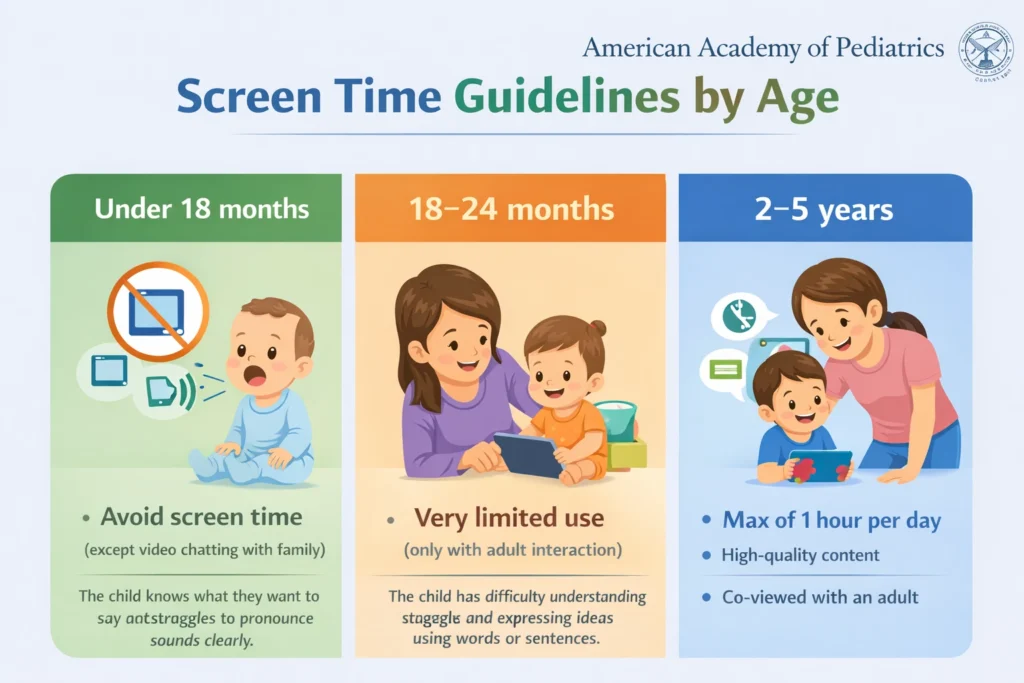
Screen Time Recommendations by Age (Updated Guidance)
Based on pediatric guidelines and recent research:
- Under 18 months:
Avoid screen time, except video chatting with family - 18–24 months:
Very limited use, only with adult interaction - 2–5 years:
Maximum of 1 hour per day, high-quality content, co-viewed with an adult
Practical Ways to Reduce Screen Impact Without Stress
Supporting speech development doesn’t require eliminating screens entirely. Small, intentional changes can make a meaningful difference:
- Turn off background TV during play and meals
- Replace screen time with short interactive play sessions
- Narrate daily routines (“We’re putting on shoes now”)
- Encourage face-to-face play and conversation
- Use screens after interaction, not instead of it
Even 10–15 minutes of focused interaction per day can significantly support language growth.
A Balanced Message for Modern Parents
Technology is not inherently harmful. When used intentionally and in moderation, it can support learning and connection.
The key is ensuring that screens support communication rather than replace it.
🔄 Transition to the Next Section
Understanding environmental influences helps explain why some children experience speech delays—but it’s only part of the picture.
Beyond milestones, red flags, and causes, parents often face another challenge that deserves equal attention: the emotional toll of navigating speech concerns.
In the next and final section, we’ll focus on coping with the emotional stress as a parent, including guilt, comparison, and when to seek support for yourself.
H2: Coping With the Emotional Stress as a Parent
When a child experiences a speech delay, the focus is often placed entirely on milestones, evaluations, and therapy plans. What is discussed far less—but felt deeply—is the emotional impact on parents.
Many parents describe this phase as confusing, exhausting, and emotionally heavy. Recognizing and addressing these feelings is not only important for parents’ well-being, but also for their child’s progress.
The Emotional Weight Parents Often Carry
Parents of children with speech delays commonly experience a mix of emotions, including:
- Guilt
Wondering if they missed early signs or made mistakes, such as allowing too much screen time - Constant comparison
Feeling distress when comparing their child’s development to peers, siblings, or children seen online - Fear of judgment
Worrying about how others interpret their child’s behavior or communication struggles - Uncertainty about the future
Questioning long-term outcomes related to school, friendships, and independence
These feelings are normal. They do not mean you are failing as a parent—they mean you care deeply about your child.
Why Parental Emotional Health Matters
Research consistently shows that parental stress can affect:
- The quality of parent-child interaction
- Emotional availability and responsiveness
- Communication opportunities during daily routines
Children thrive when caregivers are emotionally supported and regulated.
A calm, supported parent is one of the strongest foundations for a child’s communication development.
This does not mean parents must be perfect—it means they deserve support too.
Letting Go of Comparison
One of the most damaging habits for parents is constant comparison. Children develop communication skills at different rates, and comparing timelines rarely provides clarity—it often increases anxiety.
Helpful reframes include:
- Tracking progress, not perfection
- Comparing your child only to their past self
- Recognizing strengths beyond speech, such as play, empathy, or problem-solving
Language development is just one part of a child’s overall growth.
Practical Strategies to Support Yourself Emotionally
Supporting your own well-being can directly benefit your child. Consider these strategies:
- Celebrate small communication wins
- Focus on what you can control today
- Connect with other parents facing similar challenges
- Ask professionals questions without fear of judgment
- Allow yourself breaks and emotional rest
Seeking support is not a sign of weakness—it is an act of responsible parenting.
When to Seek Additional Emotional Support
You may benefit from speaking with a counselor, therapist, or support group if you:
- Feel persistently overwhelmed or anxious
- Avoid social situations due to fear or embarrassment
- Experience sleep difficulties related to worry
- Feel isolated or unsupported
Supporting your mental health is not separate from supporting your child—it is part of it.
A Final Reassuring Message for Parents
Speech delay does not define your child’s intelligence, potential, or future.
It does not define your parenting either.
By learning, asking questions, and advocating early, you are already doing something powerful.
Progress in communication is rarely instant—but with patience, support, and early action, it is very real.
🔚 Conclusion: Taking the First Step Toward Communication
Speech and language delays can feel overwhelming at first, but they are also one of the most responsive developmental challenges when addressed early.
Understanding milestones, recognizing red flags, distinguishing causes, and creating a supportive environment—both for your child and yourself—can make a lasting difference.
If you are unsure, trust your instincts and seek guidance. Early support opens doors, builds confidence, and helps children find their voice—one step at a time.
✅ : FAQ Section
❓ Is it normal for a 2-year-old to have limited speech?
Yes, some variation in speech development is normal. However, by age two, most children use at least 50 words and start combining words. If your toddler says fewer words or struggles to understand simple instructions, a professional evaluation is recommended.
❓ What are the early red flags of speech delay in toddlers?
Common red flags include:
- Not babbling by 9 months
- No meaningful words by 18 months
- Less than 50 words by age 2
- Limited eye contact or interaction
- Difficulty understanding simple directions
Early identification allows for more effective intervention.
❓ How can I help my child’s speech development at home?
Parents can support speech development by:
- Talking throughout daily routines
- Reading books together daily
- Limiting passive screen time
- Encouraging turn-taking during play
- Naming objects, actions, and emotions
Short, consistent interactions are more effective than long structured sessions.
❓ Can screen time cause speech delay in toddlers?
Excessive passive screen time has been linked to delayed expressive language. Screens reduce real-life interaction, which is essential for speech development. Interactive screen use with adult participation has less negative impact but should still be limited.
❓ How do I know if it’s autism or just a speech delay?
Speech delay alone does not indicate autism. Autism often includes additional signs such as:
- Limited social engagement
- Lack of pretend play
- Reduced response to name
- Repetitive behaviors
A speech-language pathologist and developmental pediatrician can help differentiate between the two.
❓ When should I see a speech-language pathologist (SLP)?
You should seek an evaluation if:
- Your child misses speech milestones
- You feel something is “not quite right”
- Speech difficulties cause frustration or behavior issues
You do not need to wait for a pediatrician referral in many regions.
❓ Can speech delay improve without therapy?
Some late talkers catch up naturally, but it is impossible to predict which children will. Early speech therapy does not harm children who may catch up—and can be life-changing for those who need support.