- Home
-
- Newborns (0-3 months)Your essential guide to navigating the beautiful chaos of life with a newborn. Get expert-backed, practical advice for: • Feeding Fundamentals – breastfeeding/bottle troubleshooting • Sleep Secrets – safe sleep practices & pattern decoding • Soothing Techniques – colic relief to swaddling tricks • Developmental Milestones – what to expect each week • Parent Survival Tips – self-care for exhausted caregivers
- Infants ( 4 -12 months)Your go-to resource for navigating the exciting first year of discoveries! This section provides expert guidance on: • Milestone Development – rolling, sitting, crawling to first steps • Feeding Transitions – introducing solids, allergy awareness • Sleep Patterns – establishing healthy routines • Safety Proofing – mobile baby essentials • Bonding Activities – play that supports growth “From wobbly first sits to messy food adventures – we’ve got your back through every ‘first’!” Shorter Version: “The Infant Playbook: Decoding babbling, surviving teething, and celebrating each new skill – your month-by-month guide to baby’s first year.”
- Toddlers (1-3 years)Your survival guide for parenting’s most energetic (and exhausting) phase! Get battle-tested strategies for: • Communication Breakthroughs – From first words to mini-debates • Taming Tantrums – Meltdown prevention and response • Play That Teaches – Turning daily chaos into learning moments • Safety 101 – Childproofing for tiny escape artists • Routine Magic – Making meals/naps/bedtime actually happen “Where ‘no’ becomes their favorite word, and your patience gets Olympic-level training!” Shorter Version: “Toddlerhood Unlocked: Navigating picky eating, potty training, and endless curiosity with science-backed sanity savers.” Key Tools Include: ✓ Developmental milestone tracker ✓ Power struggle diffusers ✓ Islamic manners introduction ✓ Transition tricks (Pacifier to potty)
- Preschoolers (3-5 years)Your essential toolkit for nurturing curious minds and growing independence! This section helps you: • Spark Early Learning – Fun literacy/numeracy activities • Navigate Big Emotions – Emotional regulation tools • Build Social Skills – Sharing, making friends, conflict resolution • Establish Routines – Morning/bedtime success strategies • Parenting Wins – Positive discipline that works “Where ‘why?’ becomes their favorite word, and every day brings new discoveries!” Shorter Version: “Preschool Power: Turn playtime into learning time while navigating this magical (and messy) stage of endless questions and growing independence.” Featured Resources: ✓ School readiness checklists ✓ Islamic manner builders ✓ Creative discipline techniques ✓ Developmental milestone guides
- School-Age (6-12 years)This golden age of childhood blends growing independence with lingering sweetness, as kids develop crucial academic and social skills while still valuing family connections. Our resources help you navigate homework battles, friendship dramas, and first crushes while preserving that precious parent-child bond. You’ll find practical strategies to boost confidence, instill responsibility, and handle the unique challenges of these transformative years – from managing screen time to preparing for puberty’s first changes. Whether facing school anxiety, social conflicts, or just the daily juggle of activities, we provide the tools to raise resilient, well-rounded kids during this pivotal stage.
- Teenagers (13-18 years)The rollercoaster years of self-discovery! This section helps parents navigate the delicate balance between giving wings and maintaining roots. Get expert-backed strategies for: • Communication Without Conflict – Talking with, not at, your teen • Digital World Navigation – Social media, gaming, and online safety • Academic Pressure Cooker – Managing exams and future planning • Islamic Identity – Keeping faith relevant in their evolving world
- Young Adults (18+ years)Your continued parenting playbook for when “children” become independent adults. This section offers guidance on: • The New Adult Relationship – Shifting from authority figure to trusted advisor • Life Launch Support – Career, marriage, and financial independence • Islamic Identity Reinforcement – Keeping faith central in their autonomous decisions • Digital Age Challenges – Navigating adult responsibilities in connected world
- Newborns (0-3 months)
-
- Teens & TweensNavigate the challenging adolescent years with expert-backed guidance tailored for modern Muslim families. This section offers practical strategies for communicating with eye-rolling teens, managing screen time battles, and supporting emotional development – all while maintaining Islamic values. Discover how to transform conflicts into connections, set boundaries with love, and prepare your tween/teen for adulthood through our culturally-relevant resources, real parent stories, and psychologist-approved approaches to everything from social media use to university preparation.
- Emotional GrowthHelp your child develop emotional intelligence and resilience with expert-guided strategies. This section provides age-appropriate tools to nurture self-awareness, healthy expression of feelings, and positive coping mechanisms – building a strong psychological foundation for life. Key Features: ✓ Emotion identification exercises ✓ Anxiety/stress management techniques ✓ Social skills development ✓ Parent-child bonding activities Alternative Version: “Growing Little Hearts: Your guide to raising emotionally intelligent children who can understand, express, and manage their feelings in healthy ways.” Focus Areas: Building self-esteem Managing big emotions Developing empathy Overcoming setbacks
- Health & SafetyYour trusted resource for keeping children healthy and protected at every age. Get evidence-based guidance on nutrition, illness prevention, home safety, and emergency preparedness – all presented in clear, actionable steps for busy parents. From baby-proofing checklists to handling teen mental health concerns, we translate medical expertise into practical parenting solutions. Shorter Alternative: “Childproof your parenting knowledge! Quick-access health guidelines and safety must-knows from pediatric experts – because growing kids need protection at every stage.” Key Features: ✓ Age-specific health milestones ✓ Safety certification standards ✓ First aid visual guides ✓ Pandemic-era protocols
- Learning & PlayTransform everyday moments into powerful learning opportunities! This section reveals how play builds cognitive skills, creativity, and problem-solving abilities through: • Age-appropriate play guides (0-12 years) • DIY educational toys from household items • STEAM activities disguised as fun • Cultural/Islamic play ideas “Where laughter and learning meet – because children grow smarter when they’re having fun!” Shorter Version: “Play With Purpose: Discover how to turn splashy baths into science lessons and block towers into math skills – the magic of learning through play!” Key Benefits: ✓ Develops critical thinking ✓ Enhances language skills ✓ Promotes Islamic values ✓ Adaptable for all abilities
- Parenting Self-CareYou can’t pour from an empty cup. This essential section reminds caregivers that nurturing yourself isn’t selfish – it’s survival. Discover practical ways to recharge your patience and energy through: • 5-Minute Recharge Tricks for exhausted parents • Guided Relaxation adapted for chaotic households • Emotional First Aid for parenting burnout • Partner Support Strategies to share the load
- Humor & Relief**7. Humor & Parenting Relief** Parenthood is tough – laugh your way through it! This section delivers the comic relief every parent needs, featuring hilarious parenting memes, relatable “mom fail” stories, and laugh-out-loud kid quotes that turn daily chaos into comedy gold. Discover why 93% of parents say humor is their #1 coping strategy through our: • **”They Actually Said That!”** collection of unbelievable kid logic • **Parenting meme library** for when you need to laugh instead of cry • **”Guess What My Kid Did”** anonymous confessions • **Comic strips** about those universal parenting moments *”Because sometimes the only way to survive toddler tantrums is through shared laughter!”* **Shorter Version:** “Parenting humor that gets you through the day – where spilled milk becomes comedy material and toddler tantrums turn into tomorrow’s funny story!”
- Sleep & RoutinesHelp your child (and yourself!) get the rest you need with science-backed sleep solutions and daily rhythm strategies. Discover how to: • Create calming bedtime rituals • Solve common sleep challenges • Design daily routines that reduce stress • Adapt schedules as children grow “Because well-rested families are happier families!” Shorter Version: “From bedtime battles to morning routines – reclaim your family’s rhythm with sleep solutions that actually work.” Key Features: ✓ Age-specific sleep guides ✓ Sample routine templates ✓ Gentle sleep training methods ✓ Cultural/Islamic adaptations
- Tantrums & BehaviorYour practical guide to navigating challenging behaviors with confidence and compassion. Discover effective, research-backed strategies to: • Prevent meltdowns before they start • Respond calmly to tantrums • Teach emotional regulation skills • Set loving boundaries that stick “Turning tough parenting moments into growth opportunities!” Shorter Version: “From tantrums to time-outs – decode behavior challenges and respond in ways that actually work.” What You’ll Find: ✓ Age-by-age behavior guides ✓ Positive discipline techniques ✓ Islamic parenting perspectives ✓ Real parent success stories
- Teens & Tweens
-
- 4. Child Development**4. Child Development** Your trusted resource for understanding and supporting your child’s growth journey—from first steps to adolescence. Get science-backed guidance on cognitive, emotional, physical, and social development at every age and stage. **Key Features:** ✓ **Milestone Trackers:** Know what to expect from newborns to teens ✓ **Learning Boosters:** Brain-building play ideas for each developmental phase ✓ **Behavior Decoded:** Understand the “why” behind challenging behaviors ✓ **Special Needs Support:** Inclusive strategies for all children ✓ **Parent Tools:** Turn everyday moments into growth opportunities *Backed by child psychologists and educators—because every child deserves to thrive.* 🌱 **Shorter Alternative:** **”Child Development”** Master your child’s growth journey with age-specific guides—from baby milestones to teen brain development. Science-made-simple for parents!
- 3. Family & Relationships**3. Family & Relationships** Your essential guide to stronger marriages, happier parenting, and healthier family connections – practical wisdom for modern relationships. **Or the shorter version:** **Family & Relationships** Love smarter, parent wiser, and build unbreakable bonds – research-backed advice for thriving relationships. **Or more specific:** **Family & Relationships** From date nights to parenting fights, we help you: ✓ Communicate better ✓ Resolve conflicts ✓ Balance work/family ✓ Keep love alive
- 2.Parenting & Childraising**Parenting & Childraising** A dedicated category providing parents and caregivers with expert advice, practical tips, and trusted resources for raising happy, healthy children. Covers all stages from newborns to teens, including child development, positive discipline, educational activities, and solutions for common parenting challenges. Whether you’re a first-time parent or an experienced caregiver, find guidance to nurture your child’s physical, emotional, and cognitive growth with confidence. *Topics include: parenting techniques – child psychology – learning through play – handling behavioral issues – health & nutrition for kids* 👶🧸
- 1. Education & Teaching### **Education & Teaching** This category focuses on enhancing the learning and teaching experience by providing educators, students, and parents with valuable resources, strategies, and tools. It covers modern teaching methods, curriculum development, e-learning technologies, and classroom management techniques. Whether you’re a teacher looking to improve your skills, a student seeking effective study strategies, or a parent supporting your child’s education, this category offers insights to foster academic growth and innovation. *Examples: Teacher training, educational technology, lesson planning, student engagement techniques.* 🎓📚
- 4. Child Development
- Blogs
- About
- Contact Us

It’s 7:00 PM. You’ve asked your child to put on their pajamas four times. By the fifth, your voice has risen to a pitch you don’t even recognize. They’re crying. You’re exhausted. And somehow — impossibly — the pajamas are still on the floor.
If that scene feels less like a parenting low point and more like a Tuesday, you are not failing. You are not alone. And you are not raising a “bad kid.”
You’re raising a child whose brain is doing exactly what it was designed to do — push boundaries, test autonomy, and learn where the edges are. The frustrating truth is this: defiance in children ages 2–7 isn’t a behavior problem. It’s a developmental milestone. The real problem is that most parenting advice still treats it like a war to be won.
This guide is different. Drawing on neuroscience, child psychology, and the proven frameworks of positive parenting, you’ll discover why your child’s brain literally cannot obey in the heat of a meltdown — and what to do instead. No yelling required. No guilt necessary.
What you’ll learn in this guide
- The neuroscience behind why defiant toddlers can’t “just listen” — and how knowing this changes everything
- 15 positive parenting strategies that build first-time cooperation — not fear-based compliance
- Age-specific discipline guides for 3-year-olds and 4-year-olds
- A practical “Listen-First” routine you can start using tonight — before bedtime
By the end of this page, you won’t just have a toolkit — you’ll have a completely new way of understanding your child. And that changes everything.
■ Section 2 of 9 — Personal Experience (EEAT Layer)
From the Trenches: The Day I Realized I Had Become Background Noise

I remember the exact moment I understood that my words had stopped meaning anything to my daughter.
She was three. We were in the kitchen on a Saturday morning — the kind that’s supposed to feel slow and warm but somehow always turns into a negotiation. Cereal was on the floor. The dog was barking. My coffee was cold. And I was saying “Maya, please pick that up” for what felt like the hundredth time that week.
She didn’t look up. She didn’t flinch. She just kept spinning in circles in the middle of the kitchen, completely absorbed in her own world, as if I were a television playing in another room.
“I wasn’t angry in that moment. I was something worse: invisible. And the scariest thought that crossed my mind wasn’t ‘she’s being defiant’ — it was ‘have I always sounded like this to her?'”
That question stayed with me. I started paying attention — really paying attention — to how I spoke to her throughout the day. What I noticed was uncomfortable: I was issuing a near-constant stream of instructions, corrections, and warnings. Don’t touch that. Come here. Stop. Wait. No.
By mid-morning, I had said some version of “no” or “don’t” seventeen times. Seventeen. Before lunch.
It wasn’t that Maya was ignoring me. It was that my voice had become the acoustic wallpaper of her life — always present, rarely urgent, easy to tune out. I had accidentally trained her brain to filter me.
The turning point
That evening, instead of calling her to dinner from the other room, I walked over, crouched down to her level, waited until her eyes met mine, and said — quietly, just once — “Dinner’s ready, love.”
She got up and walked to the table. No drama. No repetition. No raised voice.
I stood there genuinely stunned. Not because I’d discovered some parenting magic trick — but because I realized the problem had never been her listening. It had been the way I was asking.
KEY INSIGHT FROM THIS MOMENT Children don’t tune out parents because they’re being difficult. They tune out because repetition without connection trains their nervous system to treat your voice as low-priority background input. The fix isn’t louder — it’s closer, calmer, and more intentional. |
The shift — from commanding to connecting — is the foundation of everything in this guide.
PRO TIP — FROM A CHILD PSYCHOLOGIST’S PLAYBOOK For one full day, count how many times you say “no,” “don’t,” or “stop” to your child. Most parents are shocked to discover the number sits between 20 and 50. Once you see it, you can’t unsee it — and that awareness alone begins to shift the dynamic. Replace just three of those with a positive instruction (“leave the cup on the table” instead of “don’t touch that”) and watch what changes. |
■ Section 3 of 9 — Root Causes & Brain Science
Why Your Child Won't Listen: The Root Causes Science Actually Explains
Before you try a single new strategy, you need to understand one foundational truth: a child who won’t listen is not a child who is choosing to defy you. In most cases, they are a child whose brain is not yet equipped to do what you’re asking.
Developmental milestones vs. defiance: know the difference
The word “defiance” implies intent — a child who hears you, understands you, and deliberately chooses to ignore you. But for children ages 2–7, that’s rarely what’s happening. What looks like defiance is almost always one of three things: a developmental limitation, a bid for autonomy, or a stress response.
The prefrontal cortex — the part of the brain responsible for impulse control, following instructions, and understanding consequences — doesn’t fully mature until the mid-twenties. At age three, it’s barely online.
Age-Appropriate Expectations — Reference Table
Age | Normal behavior | What to expect | Status |
2–3 yrs | Tantrums, ‘no’ to everything, short attention span | Cannot hold two instructions at once — give one at a time | Developmentally normal |
3–4 yrs | Negotiating, testing rules, selective hearing | Beginning to understand cause/effect — natural consequences start working | Developmentally normal |
4–5 yrs | Power struggles, ‘why?’ to every instruction | Needs brief explanations — ‘because I said so’ often backfires now | Developmentally normal |
5–7 yrs | Selective compliance, arguing rules at school vs. home | Executive function developing — responds well to routines and advance warnings | Watch for patterns |
The science of the "amygdala hijack" — why your child can't obey mid-meltdown

Neuroscientist and psychiatrist Dan Siegel describes it through what he calls the “Hand Model of the Brain.” Make a fist with your thumb tucked inside your fingers. Your wrist and palm represent the brain stem (survival functions). Your thumb represents the limbic system — the emotional brain, home to the amygdala. Your fingers represent the prefrontal cortex — the rational, thinking brain.
When your child is calm, their fingers wrap over their thumb: the rational brain is “online,” connected to the emotional brain, able to regulate it. But when stress or big emotion hits, the amygdala fires — and the fingers flip up. The prefrontal cortex goes offline. Your child has “flipped their lid.”
“In that moment — mid-scream, mid-meltdown, mid-tantrum — your child is not ignoring your instructions. They are neurologically incapable of processing them. The logical brain has left the building.”
WHAT THIS MEANS IN PRACTICE: DURING A MELTDOWN, STOP TALKING, START CO-REGULATING Your calm nervous system is the most powerful tool you have. Lower your voice. Get physically close. Breathe slowly and visibly. Your child’s nervous system will begin to mirror yours — a process called co-regulation — before their rational brain can come back online. Only then is any instruction, consequence, or conversation useful. |
The strong-willed child: temperament, not a character flaw
Some children are born with what researchers call a “high-intensity” temperament — they feel things more deeply, react more strongly, and push back harder against limits. This is not stubbornness. It is not bad parenting. It is a neurological wiring that, when channeled correctly, produces some of the most resilient, creative, and determined adults.
PRO TIP — THE “ONE INSTRUCTION” RULE Research on working memory in early childhood shows that children under 5 can reliably hold and act on only one instruction at a time. The moment you say “Put your shoes on, grab your bag, and wait by the door,” you’ve lost them at step one. Strip every request down to a single, clear action. Pause. Wait for compliance. Then give the next step. |
■ Section 4 of 9 — Master Strategies
Master Strategies for First-Time Cooperation (Without Yelling Once)
The strategies below are not hacks. They are tools that work with your child’s developing brain — not against it. Used consistently, they don’t just get better short-term behavior. They build the kind of child who genuinely wants to cooperate.

THE FOUNDATIONAL PRINCIPLE “Connection before correction.” Before your child can hear your instruction, they need to feel your presence. A child who feels disconnected from you — even for five minutes — cannot access the cooperative part of their brain. The fastest path to compliance is not authority. It is relationship. |
Strategy 01 — Get physical: get on their level
Stop calling instructions from across the room. Walk over. Crouch down. Make eye contact at their height. This single shift signals to the child’s nervous system: “this is important, this is real, I am present with you.”
INSTEAD OF THIS “Maya! I said come to dinner — NOW!” (from the kitchen) |
TRY THIS Walk to Maya, crouch down, wait for eye contact. “Dinner’s ready, love. Come with me.” Then stand and walk — she will follow. |
Strategy 02 — The “When / Then” framework
Replace threats (“if you don’t do X, then Y will happen”) with logical sequences (“when you do X, then we can do Y”). One activates the stress response. The other activates motivation and agency.
THREAT (ACTIVATES DEFIANCE) “If you don’t put your shoes on, we’re not going to the park.” |
WHEN/THEN (ACTIVATES COOPERATION) “When your shoes are on, then we’re ready for the park.” |
Strategy 03 — Offer limited, genuine choices
A child who feels they have zero control over their life will manufacture control wherever they can — usually in the form of resistance. Giving two real choices hands them a piece of autonomy within your boundaries.
- Keep choices to exactly two — more creates decision paralysis in young children
- Both options must lead to the same outcome you want (e.g., getting dressed)
- State them calmly and wait — resist the urge to fill the silence
- If they don’t choose within 10 seconds, choose for them: “Looks like I’m choosing — blue shirt it is”
Strategy 04 — The “Low and Slow” voice
When a situation escalates, most parents raise their voice. But pitch and volume are contagious — a loud, high voice signals threat to the child’s nervous system. The counterintuitive move is to go lower and slower. Not quieter as in whisper — deeper, calmer, more deliberate.
Script: Drop your shoulders. Take one visible breath. Lower your voice by half. Speak at 60% of your normal pace. “I can see you’re really upset. I’m right here.”
Strategy 05 — Natural consequences over punishment
Natural consequences are what happen when you step back and let reality do the teaching. They are the most powerful discipline tool available — because the lesson comes from the world, not from you, so there’s nothing to resist.
PUNISHMENT (BREEDS RESENTMENT) “You left your bike outside so now you can’t use it for a week.” |
NATURAL CONSEQUENCE (BUILDS RESPONSIBILITY) “You left your bike outside and it got rained on. It might be rusty — that’s really frustrating. What could you do differently next time?” |
The “repeat-back” technique — 5 steps
- Give your instruction once, clearly, at eye level
- Ask: “Can you tell me what you’re going to do next?”
- Wait for them to say it in their own words
- Affirm: “Exactly right. Off you go.”
- Leave the space — hovering signals distrust and invites pushback
PRO TIP — THE “MODELING BEHAVIOR” MULTIPLIER Children between 2 and 7 are in a hyper-sensitive imitation window. Their mirror neurons are firing constantly. If you want a child who regulates their emotions, they need to see you regulate yours — out loud and visibly. Narrate it: “I’m feeling really frustrated right now, so I’m going to take three deep breaths before I respond.” |
■ Section 5 of 9 — Age-Specific Discipline Guides
Age-Specific Discipline Guides: What Works at 3, and What Works at 4

There is no single parenting script that works across all ages. A technique that calms a two-year-old mid-meltdown can feel patronizing to a five-year-old — and vice versa.
Age 3 — The year of ‘no’ and sensory-driven everything
Three-year-olds are not being defiant. They are being three. The most effective strategy at this age is not repetition. It is redirection through sensory engagement — meeting them where their nervous system already is, then gently guiding them somewhere new.
Technique 01 — Sensory redirection: swap, don’t stop
Instead of telling your 3-year-old to stop what they’re doing, offer them something equally engaging to transition into. The brain at this age moves toward stimulation, not away from it.
Script: “You love splashing — let’s go wash our hands and make the biggest soap bubbles. Come show me how.”
Technique 02 — The 5-minute warning: transition anxiety is real
Abrupt transitions are one of the biggest triggers for 3-year-old meltdowns. Their sense of time is not yet linear — “in five minutes” means nothing. What works is a physical or sensory cue that signals the change is coming.
Script: “Two more goes on the slide, then we walk to the car together. You choose which two.”
Technique 03 — Name the feeling before the instruction
A 3-year-old who is emotionally flooded cannot hear your instruction. Naming their feeling out loud activates the language center of their brain and begins to bring the emotional brain back online.
Script: “You really didn’t want to stop painting — that makes sense, it’s so fun. Take a breath with me. Now let’s put the brushes in the water.”
DO AT AGE 3
- Use play and imagination to transition
- Offer two simple choices maximum
- Give advance warnings before changes
- Name emotions before instructions
- Keep instructions under 8 words
AVOID AT AGE 3
- Long explanations or reasoning
- Timeouts longer than 3 minutes
- Asking “why did you do that?”
- Repeating the same instruction 3+ times
- Expecting immediate compliance
Age 4 — The year of ‘why’: logic is arriving, slowly
Four is a genuinely different developmental landscape from three. The prefrontal cortex has made measurable progress. At four, the most powerful tools are consistent routines and firm, calm boundary-setting.
Technique 01 — Anchor instructions to routines, not moods
When a behavior is tied to a routine — a fixed sequence that happens at the same time every day — the child’s brain stops fighting it and starts anticipating it. The routine becomes the authority, not you.
Script: “What comes after dinner in our routine?” (Let them answer.) “Right — bath time. Off we go.”
Technique 02 — Give a brief reason — once only
At four, “because I said so” reliably backfires. A brief, honest reason satisfies the emerging logical brain and dramatically increases compliance. One reason, stated once, calmly. If they argue further, don’t justify again — just hold the boundary.
Script: “Shoes go on now because the pavement is hot and it hurts bare feet. One reason, that’s it. Shoes on please.”
Technique 03 — Use ‘when/then’ with visible timelines
Four-year-olds respond strongly to visual representations of time. A simple drawn chart — “first this, then that” — removes ambiguity and gives them a concrete anchor.
Script: “Look at our chart — when the timer goes off, screens stop and we do pyjamas. You can watch the timer yourself.”
DO AT AGE 4
- Use visual routines and timers
- Give one brief reason per instruction
- Hold boundaries calmly and consistently
- Use natural consequences when safe
- Praise specific behaviors, not the child
AVOID AT AGE 4
- Negotiating after the boundary is set
- Repeating reasons when they argue back
- Inconsistent rule enforcement
- Empty threats with no follow-through
- Generic praise (“good boy/girl”)
PRO TIP — THE “PRACTICE RUN” TECHNIQUE FOR BOTH AGES Once a meltdown is over and the child is calm, use what child therapist Ross Greene calls a “re-do” — a calm rehearsal of the desired behavior in a low-stakes moment. “Let’s practice what we’ll do next time we need to leave the playground.” Children who practice a behavior when calm are significantly more likely to access it when stressed. |
■ Section 6 of 9 — Comparison Table & Checklist
Traditional Discipline vs. Positive Discipline: A Side-by-Side Reality Check
Most parents were raised with one model of discipline and are now being asked to adopt another — without a clear picture of what actually changes. This comparison isn’t about judging the past. It’s about understanding why the research has shifted.
Dimension | Traditional discipline | Positive discipline (2026) |
Core goal | Compliance through fear or consequence | Cooperation through respect and connection |
Primary method | Timeouts, shouting, threats, punishment | Time-ins, co-regulation, natural consequences |
Response to meltdown | Escalate: “Stop crying or I’ll give you something to cry about” | De-escalate: stay calm, name the feeling, co-regulate first |
How rules are set | Imposed by the adult — “because I said so” | Explained briefly and consistently — child understands the why |
When it works | Short-term — stops the behavior in the moment | Long-term — builds internalized self-regulation over time |
Long-term effect | Resentment, secretive behavior, people-pleasing or defiance | Problem-solving skills, emotional intelligence, secure attachment |
Child’s internal experience | “I am bad.” Shame-based learning | “I made a mistake.” Guilt-based learning with a path forward |
Parent’s role | Authority figure to be obeyed | Safe base — firm, warm, predictable |
The Listen-First routine — 7-step checklist
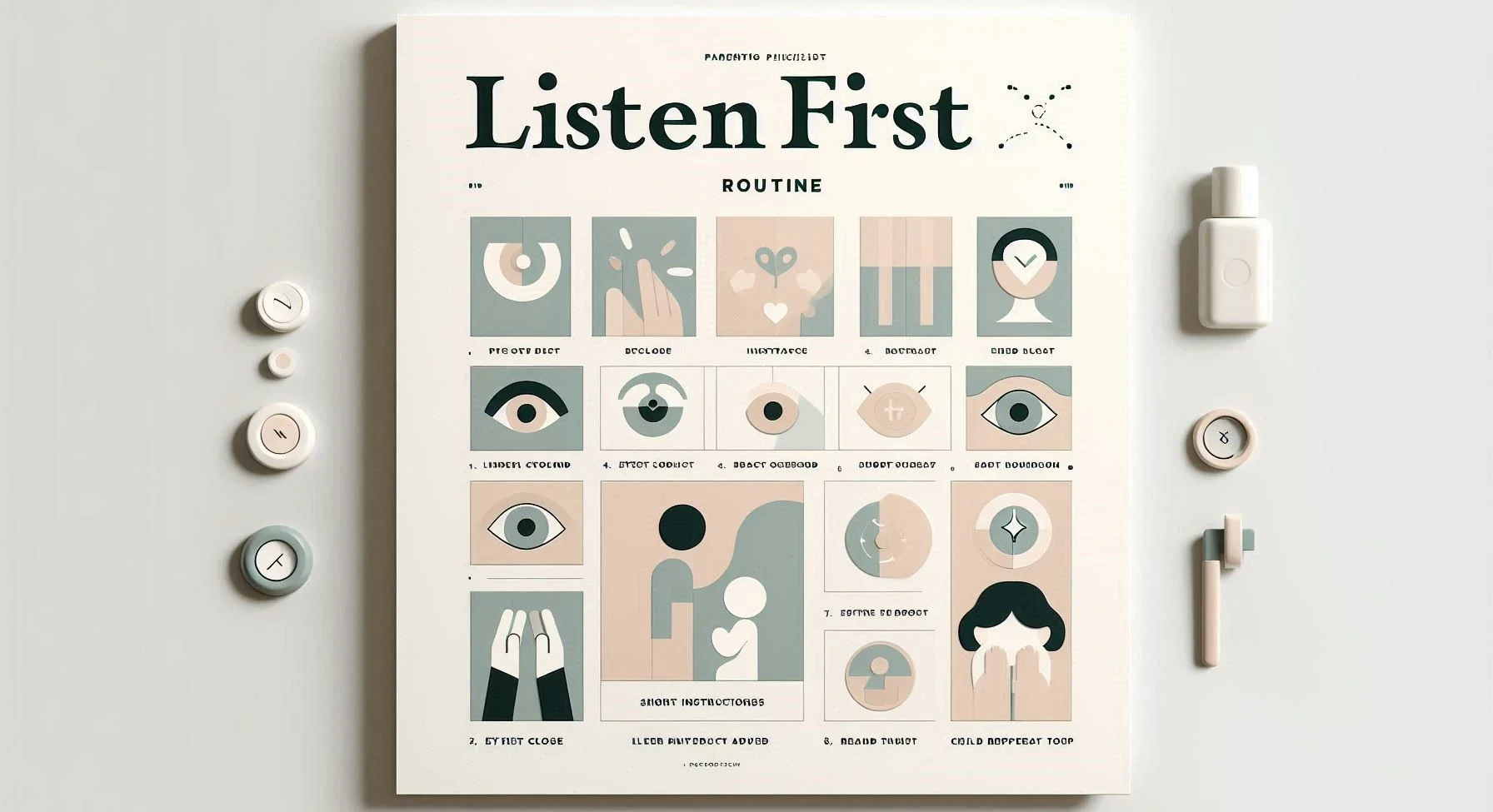
Run through this checklist every time you need your child to cooperate with an instruction. It takes under 60 seconds — and it works.
- Physical proximity established — you are within arm’s reach of your child, not calling from another room
- You are at their eye level — crouched down or seated so you’re speaking to them, not above them
- Genuine eye contact made — wait for them to look at you before you speak
- Your voice is low and calm — deliberately slower and deeper than your normal speaking voice
- Instruction is under 10 words — one action, stated once: “Shoes on please”
- Child asked to repeat it back — “Can you tell me what you’re going to do?”
- You stepped back and gave them space — hovering signals distrust
PRO TIP — SCREENSHOT THIS CHECKLIST Print or screenshot the Listen-First checklist and stick it somewhere you’ll see it during high-stress moments — the fridge, the back of the bathroom door, inside a kitchen cupboard. Research on habit formation shows it takes an average of 66 repetitions before a new behavior becomes automatic. Be patient with yourself. |
■ Section 7 of 9 — Troubleshooting Unique Scenarios
Troubleshooting Unique Scenarios: The Situations No One Warns You About
The strategies in the previous section work beautifully in calm, controlled moments. But parenting rarely happens in calm, controlled moments. This section addresses the specific, messy, real-world situations that leave parents genuinely stumped.
Scenario 01 — My child listens at school but falls apart at home
This is one of the most common and most misunderstood parenting experiences. Parents often interpret it as their child “choosing” to behave for teachers but not for them — a sign of disrespect. The reality is almost the opposite.
WHAT’S ACTUALLY HAPPENING: RESTRAINT COLLAPSE All day at school, your child is working extraordinarily hard to hold it together. By the time they reach you — their safe person — the effort collapses. They fall apart at home because they feel safe enough to. The meltdown is not a rejection of your authority. It is the highest form of trust. |
- Create a 15–20 minute “decompression window” the moment they arrive home — no demands, no questions, no homework
- Resist asking “how was your day?” immediately — their nervous system needs to downregulate first
- After the window, reconnect physically — a hug, sitting together — before any instructions
- Communicate with their teacher about what’s hard at school
What to say when they walk through the door: “I’m so glad you’re home. Snack’s on the table. I’m right here.” Nothing else — for at least 15 minutes.
Scenario 02 — Defiance spiked after daycare started
Starting daycare or preschool is one of the biggest neurological events in a young child’s life. Even when they seem to love it, the adjustment involves navigating a new attachment figure, an unfamiliar environment, and the loss of one-on-one parental attention — all simultaneously.
WHAT’S ACTUALLY HAPPENING: TRANSITION STRESS AND ATTACHMENT ACTIVATION Increased defiance in the weeks after a new childcare setting is a reliable sign that your child’s attachment system is activated — they are testing whether you are still their secure base. The behaviour that looks like pushback is actually a question: “Are you still there for me even when I’m difficult?” |
- Increase physical connection time — skin contact, cuddles, roughhousing — which directly regulates the stress hormone cortisol
- Create a predictable goodbye ritual at drop-off — the same words, same gesture, every single time
- Acknowledge the transition openly: “Starting at a new place is really hard. It’s okay to feel wobbly about it.”
- Expect 4–6 weeks for full adjustment — if severe distress continues beyond 6 weeks, consult your pediatrician
Scenario 03 — My partner and I are not on the same page
Children between ages 2 and 7 are exquisitely sensitive to inconsistency between caregivers. They are not being manipulative when they play one parent against the other — they are doing exactly what their developing brain is wired to do: find the path of least resistance.
WHY CONSISTENCY BETWEEN CAREGIVERS IS NON-NEGOTIABLE Children build their internal model of “how the world works” from repeated, consistent experiences. When caregivers send different signals, that model stays fragmented — which generates anxiety, not freedom. A child with clear, consistent boundaries from both parents is paradoxically calmer and more cooperative. |
- Schedule a weekly 10-minute “alignment check” with your partner — agree on the top three non-negotiable house rules for that week
- Never overrule your partner in front of the child — resolve it privately
- Create a shared visual routine chart — when the chart is the authority, neither parent has to be the “bad guy”
- Use identical language for key instructions — if one parent says “shoes on please” and the other says “get your shoes NOW,” the child registers these as different commands
The alignment phrase: “What’s the one behavior we most want to work on this week, and what’s our shared response when it happens?” One behavior. One response. Agreed in advance.
PRO TIP — THE HIDDEN GEM MOST PARENTS NEVER CONSIDER When a child’s defiance is sudden, severe, or out of character — and none of the usual strategies are working — rule out the physical before addressing the behavioral. Hunger, sleep deprivation, sensory overload, illness, and undiagnosed hearing difficulties are among the most common and most overlooked drivers of apparent defiance in children under 7. |
■ Section 8 of 9 — FAQ (Schema-Ready)
Frequently Asked Questions: Direct Answers to What Parents Actually Search For
These are the questions parents type into Google at 11pm, exhausted and second-guessing themselves. Each answer is written to be immediately useful — no fluff, no vague reassurance, just the direct answer you came for.
Q: Why is my child ignoring me all the time?
DIRECT ANSWER (Featured Snippet)
Children ignore parents not out of disrespect, but due to auditory filtering during deep play, a breakdown in emotional connection, or a lack of clear and consistent boundaries. In most cases, the fix is proximity and connection — not repetition or volume.
When your voice has become a constant background sound — always present, rarely followed by real consequence or connection — the brain begins to deprioritize it automatically. This is not defiance. It is neurology.
- Move physically closer before you speak — proximity is step one, always
- Wait for eye contact before giving your instruction
- Use empathetic listening — acknowledge what they’re doing before redirecting
- Say it once. Don’t repeat. Follow through calmly if they don’t respond within 30 seconds
Q: How do I discipline a defiant child without yelling?
DIRECT ANSWER (Featured Snippet)
Discipline a defiant child without yelling by using a “Low and Slow” voice, natural consequences instead of punishments, and time-ins rather than timeouts. The goal is co-regulation first — helping the child’s nervous system calm down — before any instruction or consequence can be heard.
Yelling triggers the child’s stress response, flooding their brain with cortisol and making cooperation neurologically impossible in that moment. Every time you yell and it “works,” what you’ve actually done is frightened the child into compliance — which builds resentment, not cooperation, over time.
- Use “Low and Slow” — deliberately lower your pitch and slow your pace when tension rises
- Replace timeouts with time-ins: sit with your child, regulate together, then address the behavior
- Use natural consequences — let reality teach the lesson instead of your anger
- If you feel yourself about to yell, narrate it out loud: “I’m feeling really frustrated — I’m going to take a breath before I respond”
Q: What are the best books on parenting kids who won’t listen?
DIRECT ANSWER (Featured Snippet)
The most evidence-based books for parents of children who won’t listen include The Whole-Brain Child by Dan Siegel, How to Talk So Little Kids Will Listen by Joanna Faber, and No-Drama Discipline by Dan Siegel and Tina Payne Bryson — all grounded in neuroscience and practical for daily use.
- The Whole-Brain Child — Dan Siegel & Tina Payne Bryson — best for understanding the neuroscience behind meltdowns
- How to Talk So Little Kids Will Listen — Joanna Faber & Julie King — best for practical, script-ready communication tools for ages 2–7
- No-Drama Discipline — Dan Siegel & Tina Payne Bryson — best for replacing punishment-based approaches
- Janet Lansbury — Elevating Child Care — free resources and podcast on respectful, RIE-based approaches
Q: How do I handle a toddler who won’t listen during meltdowns?
DIRECT ANSWER (Featured Snippet)
During a toddler meltdown, stop talking and start co-regulating. The logical brain is offline — no instruction, reason, or consequence can be processed. Prioritize safety, stay physically close, breathe slowly and visibly, and wait. Once the child is calm, use a “re-do” to practice the desired behavior together.
The most common mistake parents make during a meltdown is continuing to talk — repeating the instruction, explaining the consequence, asking the child to calm down. All of this adds verbal input to an already overwhelmed nervous system and prolongs the episode.
- Stop all verbal instruction the moment the meltdown begins
- Get close — sit on the floor near them, don’t loom above
- Breathe slowly and audibly — your calm nervous system is contagious
- Once calm: “That was really hard. Let’s try that again.” — then do the re-do
- Never apply consequences during or immediately after a meltdown
Q: Is it normal for a 3-year-old to completely ignore you?
DIRECT ANSWER (Featured Snippet)
Yes — it is completely normal for a 3-year-old to appear to ignore instructions. At this age, the prefrontal cortex is still in very early development, the brain’s auditory filtering system deprioritizes verbal input during deep play, and the drive for autonomy is at a developmental peak. It is not defiance. It is biology.
Parents who understand this distinction — between developmental limitation and deliberate defiance — consistently report lower stress and better outcomes. If ignoring is accompanied by no response to their name or significant speech delays, consult your pediatrician to rule out hearing or developmental concerns.
PRO TIP — MAKE YOUR FAQ WORK HARDER FOR SEO Every question in this FAQ section corresponds to a real search query typed by parents in the US, UK, and Australia. When you publish this article, add FAQ Schema markup to these questions using JSON-LD structured data. Google will pull the snippet answer directly into the search results page — giving you a second listing below your main result and dramatically increasing click-through rate. |
■ Section 9 of 9 — Conclusion & CTA
The Path to a Peaceful Home: From Control to Connection
You came to this page because your child wasn’t listening. You’re leaving it with something far more valuable than a list of tricks: a completely new framework for understanding why they weren’t listening — and a toolkit built on how their brain actually works.
The shift from control to connection is not a parenting strategy. It is a decision about the kind of relationship you want to build with your child — one that will outlast toddlerhood, survive the teenage years, and echo in how they one day parent their own children.
None of this is about being a perfect parent. Perfect parents don’t exist, and children don’t need them. What children need is a parent who is present, predictable, and willing to repair when things go wrong. That’s it. That’s the whole job.
What this guide gave you — at a glance
- 15+ science-backed strategies for first-time cooperation
- Age-specific guides for 3-year-olds and 4-year-olds with scripts ready to use
- The 7-step Listen-First routine — start tonight
- 3 real-world troubleshooting scenarios with step-by-step solutions
- 5 FAQ answers schema-ready for Google Featured Snippets
The core shifts this guide makes possible
- Repeating yourself → Saying it once, at eye level
- Reacting to the behavior → Understanding the cause
- Yelling to be heard → Going low and slow
- Punishing the meltdown → Co-regulating through it
- Demanding compliance → Building cooperation
- Control as the goal → Connection as the foundation
Start with one strategy tonight. Just one. The Listen-First checklist is the easiest entry point — it takes under 60 seconds and costs nothing. Run through it the next time you need your child to do something. Notice what changes.
Then tomorrow, try another. This is not a transformation that happens in a day. It is a practice — built one interaction, one repair, one calm breath at a time. But it compounds. And six weeks from now, you will look back at who you both were on page one of this guide, and the distance will surprise you.
FREE RESOURCE — TAKE THE NEXT STEP Download the Positive Parenting Workbook — printable worksheets, daily routine charts, and the complete Listen-First checklist — everything in this guide, in one place, ready to use from day one. |
Or if you found this guide useful, share it with one parent who needs it tonight. Because the child who won’t listen is usually the child of a parent who just needed better tools.
A NOTE ON THE JOURNEY AHEAD There will be days when none of this works. When you’re tired, they’re tired, and the connection feels impossible. On those days, the most important thing you can do is repair — a simple “I got frustrated and raised my voice. I’m sorry. Let’s try again.” That repair, modelled consistently, teaches your child something no strategy can: that relationships can withstand rupture, and that love is not conditional on perfect behavior. Theirs, or yours. |