- Home
-
- Newborns (0-3 months)Your essential guide to navigating the beautiful chaos of life with a newborn. Get expert-backed, practical advice for: • Feeding Fundamentals – breastfeeding/bottle troubleshooting • Sleep Secrets – safe sleep practices & pattern decoding • Soothing Techniques – colic relief to swaddling tricks • Developmental Milestones – what to expect each week • Parent Survival Tips – self-care for exhausted caregivers
- Infants ( 4 -12 months)Your go-to resource for navigating the exciting first year of discoveries! This section provides expert guidance on: • Milestone Development – rolling, sitting, crawling to first steps • Feeding Transitions – introducing solids, allergy awareness • Sleep Patterns – establishing healthy routines • Safety Proofing – mobile baby essentials • Bonding Activities – play that supports growth “From wobbly first sits to messy food adventures – we’ve got your back through every ‘first’!” Shorter Version: “The Infant Playbook: Decoding babbling, surviving teething, and celebrating each new skill – your month-by-month guide to baby’s first year.”
- Toddlers (1-3 years)Your survival guide for parenting’s most energetic (and exhausting) phase! Get battle-tested strategies for: • Communication Breakthroughs – From first words to mini-debates • Taming Tantrums – Meltdown prevention and response • Play That Teaches – Turning daily chaos into learning moments • Safety 101 – Childproofing for tiny escape artists • Routine Magic – Making meals/naps/bedtime actually happen “Where ‘no’ becomes their favorite word, and your patience gets Olympic-level training!” Shorter Version: “Toddlerhood Unlocked: Navigating picky eating, potty training, and endless curiosity with science-backed sanity savers.” Key Tools Include: ✓ Developmental milestone tracker ✓ Power struggle diffusers ✓ Islamic manners introduction ✓ Transition tricks (Pacifier to potty)
- Preschoolers (3-5 years)Your essential toolkit for nurturing curious minds and growing independence! This section helps you: • Spark Early Learning – Fun literacy/numeracy activities • Navigate Big Emotions – Emotional regulation tools • Build Social Skills – Sharing, making friends, conflict resolution • Establish Routines – Morning/bedtime success strategies • Parenting Wins – Positive discipline that works “Where ‘why?’ becomes their favorite word, and every day brings new discoveries!” Shorter Version: “Preschool Power: Turn playtime into learning time while navigating this magical (and messy) stage of endless questions and growing independence.” Featured Resources: ✓ School readiness checklists ✓ Islamic manner builders ✓ Creative discipline techniques ✓ Developmental milestone guides
- School-Age (6-12 years)This golden age of childhood blends growing independence with lingering sweetness, as kids develop crucial academic and social skills while still valuing family connections. Our resources help you navigate homework battles, friendship dramas, and first crushes while preserving that precious parent-child bond. You’ll find practical strategies to boost confidence, instill responsibility, and handle the unique challenges of these transformative years – from managing screen time to preparing for puberty’s first changes. Whether facing school anxiety, social conflicts, or just the daily juggle of activities, we provide the tools to raise resilient, well-rounded kids during this pivotal stage.
- Teenagers (13-18 years)The rollercoaster years of self-discovery! This section helps parents navigate the delicate balance between giving wings and maintaining roots. Get expert-backed strategies for: • Communication Without Conflict – Talking with, not at, your teen • Digital World Navigation – Social media, gaming, and online safety • Academic Pressure Cooker – Managing exams and future planning • Islamic Identity – Keeping faith relevant in their evolving world
- Young Adults (18+ years)Your continued parenting playbook for when “children” become independent adults. This section offers guidance on: • The New Adult Relationship – Shifting from authority figure to trusted advisor • Life Launch Support – Career, marriage, and financial independence • Islamic Identity Reinforcement – Keeping faith central in their autonomous decisions • Digital Age Challenges – Navigating adult responsibilities in connected world
- Newborns (0-3 months)
-
- Teens & TweensNavigate the challenging adolescent years with expert-backed guidance tailored for modern Muslim families. This section offers practical strategies for communicating with eye-rolling teens, managing screen time battles, and supporting emotional development – all while maintaining Islamic values. Discover how to transform conflicts into connections, set boundaries with love, and prepare your tween/teen for adulthood through our culturally-relevant resources, real parent stories, and psychologist-approved approaches to everything from social media use to university preparation.
- Emotional GrowthHelp your child develop emotional intelligence and resilience with expert-guided strategies. This section provides age-appropriate tools to nurture self-awareness, healthy expression of feelings, and positive coping mechanisms – building a strong psychological foundation for life. Key Features: ✓ Emotion identification exercises ✓ Anxiety/stress management techniques ✓ Social skills development ✓ Parent-child bonding activities Alternative Version: “Growing Little Hearts: Your guide to raising emotionally intelligent children who can understand, express, and manage their feelings in healthy ways.” Focus Areas: Building self-esteem Managing big emotions Developing empathy Overcoming setbacks
- Health & SafetyYour trusted resource for keeping children healthy and protected at every age. Get evidence-based guidance on nutrition, illness prevention, home safety, and emergency preparedness – all presented in clear, actionable steps for busy parents. From baby-proofing checklists to handling teen mental health concerns, we translate medical expertise into practical parenting solutions. Shorter Alternative: “Childproof your parenting knowledge! Quick-access health guidelines and safety must-knows from pediatric experts – because growing kids need protection at every stage.” Key Features: ✓ Age-specific health milestones ✓ Safety certification standards ✓ First aid visual guides ✓ Pandemic-era protocols
- Learning & PlayTransform everyday moments into powerful learning opportunities! This section reveals how play builds cognitive skills, creativity, and problem-solving abilities through: • Age-appropriate play guides (0-12 years) • DIY educational toys from household items • STEAM activities disguised as fun • Cultural/Islamic play ideas “Where laughter and learning meet – because children grow smarter when they’re having fun!” Shorter Version: “Play With Purpose: Discover how to turn splashy baths into science lessons and block towers into math skills – the magic of learning through play!” Key Benefits: ✓ Develops critical thinking ✓ Enhances language skills ✓ Promotes Islamic values ✓ Adaptable for all abilities
- Parenting Self-CareYou can’t pour from an empty cup. This essential section reminds caregivers that nurturing yourself isn’t selfish – it’s survival. Discover practical ways to recharge your patience and energy through: • 5-Minute Recharge Tricks for exhausted parents • Guided Relaxation adapted for chaotic households • Emotional First Aid for parenting burnout • Partner Support Strategies to share the load
- Humor & Relief**7. Humor & Parenting Relief** Parenthood is tough – laugh your way through it! This section delivers the comic relief every parent needs, featuring hilarious parenting memes, relatable “mom fail” stories, and laugh-out-loud kid quotes that turn daily chaos into comedy gold. Discover why 93% of parents say humor is their #1 coping strategy through our: • **”They Actually Said That!”** collection of unbelievable kid logic • **Parenting meme library** for when you need to laugh instead of cry • **”Guess What My Kid Did”** anonymous confessions • **Comic strips** about those universal parenting moments *”Because sometimes the only way to survive toddler tantrums is through shared laughter!”* **Shorter Version:** “Parenting humor that gets you through the day – where spilled milk becomes comedy material and toddler tantrums turn into tomorrow’s funny story!”
- Sleep & RoutinesHelp your child (and yourself!) get the rest you need with science-backed sleep solutions and daily rhythm strategies. Discover how to: • Create calming bedtime rituals • Solve common sleep challenges • Design daily routines that reduce stress • Adapt schedules as children grow “Because well-rested families are happier families!” Shorter Version: “From bedtime battles to morning routines – reclaim your family’s rhythm with sleep solutions that actually work.” Key Features: ✓ Age-specific sleep guides ✓ Sample routine templates ✓ Gentle sleep training methods ✓ Cultural/Islamic adaptations
- Tantrums & BehaviorYour practical guide to navigating challenging behaviors with confidence and compassion. Discover effective, research-backed strategies to: • Prevent meltdowns before they start • Respond calmly to tantrums • Teach emotional regulation skills • Set loving boundaries that stick “Turning tough parenting moments into growth opportunities!” Shorter Version: “From tantrums to time-outs – decode behavior challenges and respond in ways that actually work.” What You’ll Find: ✓ Age-by-age behavior guides ✓ Positive discipline techniques ✓ Islamic parenting perspectives ✓ Real parent success stories
- Teens & Tweens
-
- 4. Child Development**4. Child Development** Your trusted resource for understanding and supporting your child’s growth journey—from first steps to adolescence. Get science-backed guidance on cognitive, emotional, physical, and social development at every age and stage. **Key Features:** ✓ **Milestone Trackers:** Know what to expect from newborns to teens ✓ **Learning Boosters:** Brain-building play ideas for each developmental phase ✓ **Behavior Decoded:** Understand the “why” behind challenging behaviors ✓ **Special Needs Support:** Inclusive strategies for all children ✓ **Parent Tools:** Turn everyday moments into growth opportunities *Backed by child psychologists and educators—because every child deserves to thrive.* 🌱 **Shorter Alternative:** **”Child Development”** Master your child’s growth journey with age-specific guides—from baby milestones to teen brain development. Science-made-simple for parents!
- 3. Family & Relationships**3. Family & Relationships** Your essential guide to stronger marriages, happier parenting, and healthier family connections – practical wisdom for modern relationships. **Or the shorter version:** **Family & Relationships** Love smarter, parent wiser, and build unbreakable bonds – research-backed advice for thriving relationships. **Or more specific:** **Family & Relationships** From date nights to parenting fights, we help you: ✓ Communicate better ✓ Resolve conflicts ✓ Balance work/family ✓ Keep love alive
- 2.Parenting & Childraising**Parenting & Childraising** A dedicated category providing parents and caregivers with expert advice, practical tips, and trusted resources for raising happy, healthy children. Covers all stages from newborns to teens, including child development, positive discipline, educational activities, and solutions for common parenting challenges. Whether you’re a first-time parent or an experienced caregiver, find guidance to nurture your child’s physical, emotional, and cognitive growth with confidence. *Topics include: parenting techniques – child psychology – learning through play – handling behavioral issues – health & nutrition for kids* 👶🧸
- 1. Education & Teaching### **Education & Teaching** This category focuses on enhancing the learning and teaching experience by providing educators, students, and parents with valuable resources, strategies, and tools. It covers modern teaching methods, curriculum development, e-learning technologies, and classroom management techniques. Whether you’re a teacher looking to improve your skills, a student seeking effective study strategies, or a parent supporting your child’s education, this category offers insights to foster academic growth and innovation. *Examples: Teacher training, educational technology, lesson planning, student engagement techniques.* 🎓📚
- 4. Child Development
- Blogs
- About
- Contact Us
How to Raise Independent & Responsible Kids (10 Proven Strategies That Actually Work
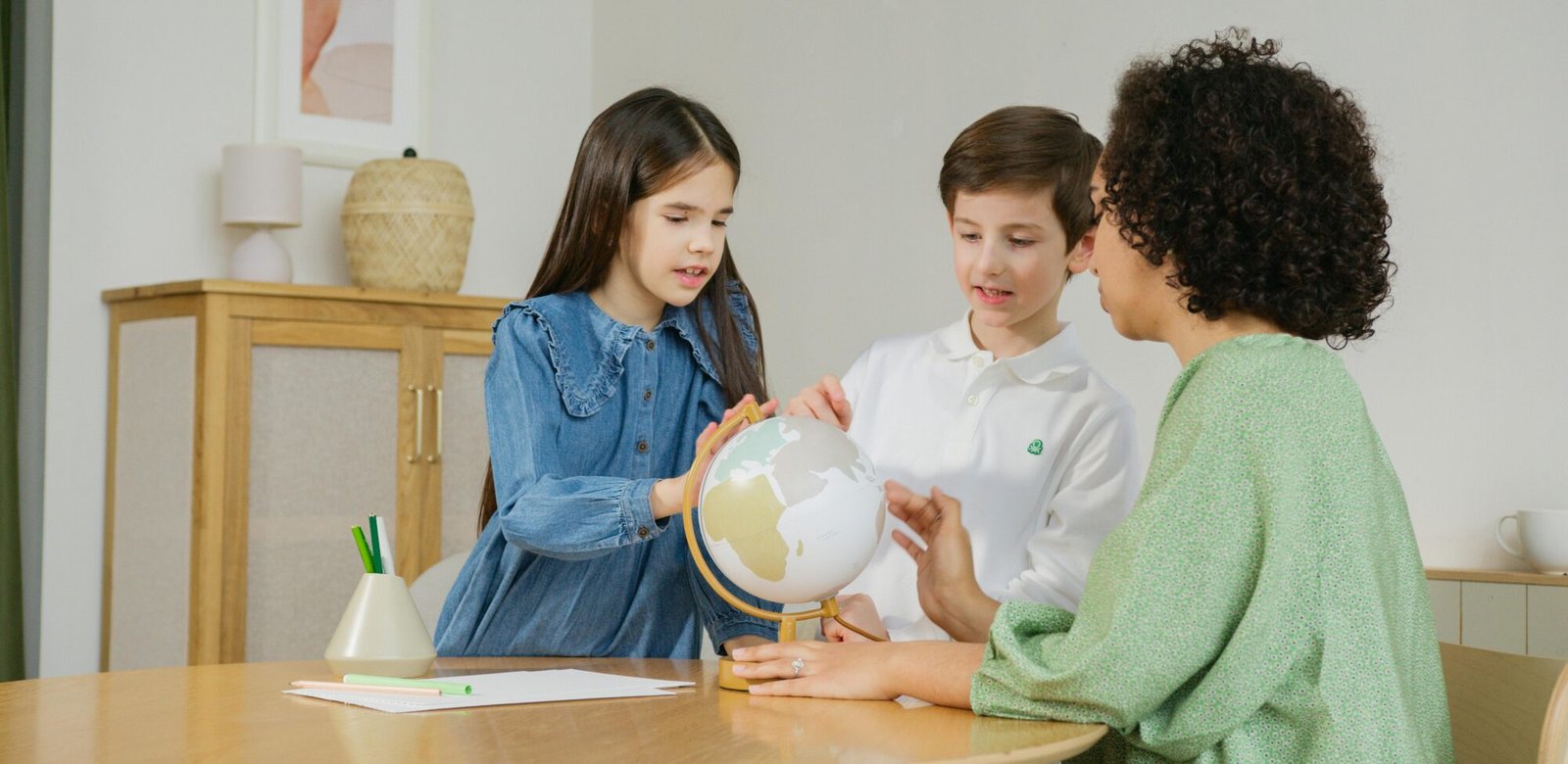
You’re standing in the kitchen at 5:00 PM on a Tuesday. The floor is covered in cereal. Your child is staring at you — not at the mess, not at the cabinet where the dustpan lives — at you. Waiting. Expecting you to fix it.
And the worst part? You probably will.
Not because you’re a pushover. Not because you lack discipline. But because it’s faster, quieter, and frankly less exhausting than the fifteen-minute negotiation that follows if you don’t. If that scenario sounds uncomfortably familiar, you’re not alone — and you’re not failing. You’re just caught in one of the most common traps of modern parenting: doing too much, for too long, for kids who are far more capable than we give them credit for.
Here’s the uncomfortable truth most parenting books dance around: every time you rescue your child from a manageable struggle, you’re not helping them — you’re borrowing against their future confidence.
The goal of this guide isn’t to turn you into a hands-off parent or hand you a rigid chore chart to print and laminate. It’s something more nuanced than that. By the time you finish reading, you’ll have a science-backed, field-tested roadmap for shifting your home from a place where you carry all the weight to one where your kids show up — genuinely, willingly, and with something that looks a lot like pride.
No tiger parenting. No guilt trips. Just practical strategies that actually work.
What you’ll learn:
- Why capable kids still act helpless (and the psychology behind it)
- The “Scaffolding” method that builds real independence, step by step
- Age-appropriate ways to hand over responsibility without the meltdowns
- How to respond when your child resists — because they will
- The small daily shifts that create lifelong self-reliance
Stage 2: The "Spilled Milk" Moment — A View from the Trenches

The Day I Stopped Saving My Kid From Himself
Three months ago, on an ordinary Wednesday morning, I had what I can only describe as a parenting wake-up call — and it came disguised as a puddle of orange juice.
My 7-year-old, Marcus, wanted to pour his own glass. I was standing three feet away, lukewarm coffee in hand, already mentally calculating the odds. I’d seen this movie before. The carton was full, the glass was small, and his coordination — bless him — was still a work in progress. Every instinct I had screamed the same thing: just do it yourself, it’ll take four seconds.
But I didn’t. I held back.
What happened next was almost cinematic in its predictability. The carton tilted too far, the juice moved faster than he expected, and within seconds we had a glossy, orange lake spreading across the hardwood floor — heading, with quiet determination, toward the edge of the counter and onto the rug below.
In the past, I know exactly what I would have done. I would have sighed — that specific, tight-lipped sigh that communicates disappointment without technically saying anything — grabbed the paper towels myself, cleaned it up in ninety seconds, and moved on. Efficient. Tidy. And completely useless to him.
That morning, I did something different. I took a breath, crouched down to his level, and said: “Okay. What do we need to fix this?”
He looked at me for a moment like I’d asked him to solve a calculus problem. Then something shifted. He went to the cabinet, pulled out the dish towel, and got to work. It took him eleven minutes to clean what I could have handled in two. The floor was still faintly sticky by lunchtime. I didn’t say a word about it.
But here’s what I noticed: when he was done, he stood up straight. He looked at the floor, then at me, and there was something in his expression that I hadn’t seen before in that context — not relief that I had fixed it, but satisfaction that he had.
That’s the moment I began to understand what independence actually looks like in practice. It isn’t a child who never spills anything. It’s a child who knows what to do when they do.
Why We Keep Jumping In (And Why It Makes Sense)
Before we go any further, I want to be clear about something: the instinct to step in and help your child isn’t a character flaw. It’s deeply human. In fact, it’s neurological.
When your child struggles — when they’re frustrated, crying, failing at something — your brain registers that as a threat signal. Your stress response activates. Helping them isn’t just kindness; it relieves your own discomfort just as much as theirs. That’s not a parenting failure. That’s biology.
The problem isn’t the impulse. The problem is what happens when we act on it every single time, without pause, without asking whether this is a struggle our child actually needs us to rescue them from — or one they need to move through.
Psychologists call the result learned helplessness: a state in which a child, having been consistently rescued from difficulty, begins to genuinely believe they are incapable of managing challenges on their own. It’s not defiance. It’s not laziness. It’s a belief system — one we accidentally built, brick by brick, every time we tied the shoes they could have tied themselves, every time we answered the question they could have figured out, every time we cleaned up the mess before they had the chance to try.
The good news? Belief systems can be rebuilt. And it starts with staying in the room and putting down the paper towels.
A note before we move on: Nothing in this guide asks you to be cold, withhold comfort, or turn struggle into suffering. The line between productive difficulty and genuine distress is real, and you know your child better than any framework does. What we’re talking about here is the manageable hard — the zipper, the spilled juice, the homework problem that takes fifteen minutes instead of five. That’s the territory where independence is built, one small moment at a time.
Stage 3: The "Scaffolding" Method — Building Independence Step by Step
The Best Parenting Tool You've Never Heard Of
Here’s a question worth sitting with: when you learned to drive, did someone simply hand you the keys and wish you luck?
Of course not. There was a passenger seat instructor, a parking lot with no other cars, a quiet residential street before the highway ever entered the picture. The challenge expanded as your competence did — not before, not after. Someone was there until they didn’t need to be anymore, and then they stepped back.
That’s scaffolding. And it’s the single most effective framework for building genuine independence in children that developmental psychology has produced in the last half century.
The term comes from the work of Soviet psychologist Lev Vygotsky, who argued that children learn best not when tasks are too easy or overwhelming, but when they’re operating just at the edge of their current ability — with the right amount of support to keep them from falling. He called this space the Zone of Proximal Development. We can think of it more simply as the place where growth actually happens.
The scaffolding itself — your involvement, your guidance, your presence — is always temporary. The goal, from the very first moment, is to make itself unnecessary.
Here’s how it works in practice.
The 5 Stages of Scaffolding (With Real-Life Examples)
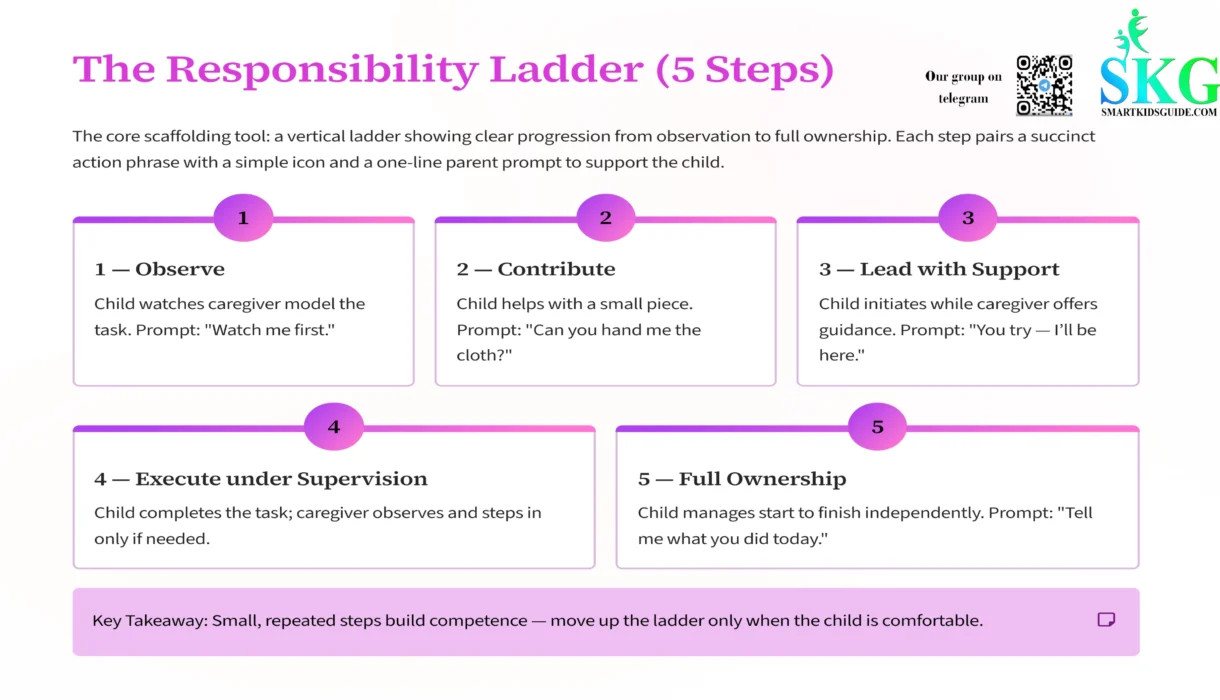
Stage 1: “I Do, You Watch”
This is where everything begins — not with instruction, but with narrated demonstration.
You perform the task in full, out loud, as if you’re a sports commentator describing your own actions. You’re not lecturing. You’re thinking out loud, making your invisible reasoning visible.
What it sounds like: “I’m sorting the laundry now. I’m putting the white socks in this pile because if they go in with the dark clothes, they’ll come out grey. See how I’m checking the tag on this shirt? That tells me whether it can go in hot water or if it needs to be washed cold.”
This matters more than it sounds. Children absorb process long before they can execute it. When you narrate your thinking, you’re not just showing them what to do — you’re showing them how to think through what to do. That’s the deeper skill.
Works for: Any new task your child has never attempted — tying shoes, making a sandwich, organizing a backpack, writing a grocery list.
Stage 2: “I Do, You Help”
Now you bring them into the task — but in a small, low-pressure way. You’re still leading. You’re simply creating a natural opening for their contribution.
The key here is the micro-contribution: a single, manageable action embedded within a larger task you’re still controlling.
What it sounds like: “Can you find the match for this blue sock?” “Hold this end of the sheet while I tuck in the corner.” “You pick which vegetables go in the salad — I’ll do the cutting.”
This stage does something important psychologically: it creates ownership without overwhelm. Your child is part of the process, they’ve contributed something real, and they haven’t been set up to fail. That combination — participation plus success — is precisely what begins building the “I can do this” neural pathway.
Don’t rush past this stage. For children who have been on the receiving end of a lot of parental doing, this is where trust gets rebuilt — theirs in themselves, and yours in them.
Stage 3: “You Do, I Help”
This is where the balance tips. Your child takes the lead — and you become the supporting role you were always meant to be.
Your job in this stage is what child development specialists call “just-in-time” support: you don’t intervene unless they’ve genuinely hit a wall, and even then, you ask before you act.
What just-in-time support sounds like:
- “You’re doing great. What do you think comes next?”
- “Looks like you’re stuck. Do you want a hint or do you want to try a bit longer?”
- “That didn’t work — what else could we try?”
Notice what’s absent from all of those: the answer. You’re not solving it. You’re keeping them in the problem rather than pulling them out of it. This is harder than it sounds, especially when you can see the solution clearly and they’re circling around it. Sit with that discomfort. It’s doing more good than you know.
The critical mistake to avoid at this stage: Correcting minor errors in real time. If your child folds the towel slightly unevenly, let it go. If they put the fork on the wrong side of the plate, let it go. Perfectionism at this stage doesn’t raise standards — it raises anxiety and kills motivation. Save your feedback for what actually matters.
Stage 4: “You Do, I Watch”
You are now present but hands-off. Physically in the room — available if truly needed — but silent. Resisting. Watching.
This stage is arguably the hardest one for parents, and it’s not because children struggle with it. It’s because we do. We’ve been so conditioned to equate our involvement with our value as a parent that stepping back can feel, irrationally but genuinely, like neglect.
It isn’t. It’s the whole point.
What this looks like in real life: Your child packs their school bag while you sit at the kitchen table with your coffee. You don’t remind them about their library book. You don’t check whether they’ve put their homework folder in. You watch — and you let the natural consequences of any forgotten item be the teacher tomorrow morning.
That’s not cruelty. That’s one of the most powerful learning mechanisms available to you, and it costs nothing.
A word on natural consequences: There is a meaningful difference between consequences that teach and consequences that harm. A forgotten library book — teaches. A forgotten winter coat on a cold day — teaches. Missing an important exam because no one reminded them — that’s a conversation worth having first. Use your judgment. The framework is a guide, not a substitute for knowing your child.
Stage 5: Full Independence
The scaffolding comes down. The task belongs to them entirely — not because you assigned it, but because they’ve moved through enough repetition, enough supported success, enough small failures and recoveries, that it no longer requires your presence to happen.
This doesn’t mean they’ll do it perfectly. It means they’ll do it.
And on the days they don’t — on the days the cereal ends up on the floor again or the school bag gets packed wrong or the chore gets done badly — you’ll know exactly what to do. You’ll hand them the cloth. You’ll ask what comes next. You’ll watch them figure it out.
Because that’s what you’ve been building toward all along.
Why This Works: The Science in Plain English
When a child successfully completes a scaffolded task — even a small one — their brain releases dopamine. Not metaphorically. Literally. The neurochemical associated with reward and motivation fires, and it reinforces a specific belief: I did that. I can do this.
Over time, with repetition, that belief becomes something more durable: intrinsic motivation — the internal drive to take on challenges not because someone is watching or because there’s a reward waiting, but because competence itself feels good.
This is what separates kids who grow into capable, self-directed adults from those who continue waiting for someone else to hand them the paper towels. It isn’t talent. It isn’t temperament. It’s the accumulation of small, supported wins — and the adults who had the patience to step back and let them happen.
Quick-Reference: The Scaffolding Stages at a Glance
Stage | Your Role | Child’s Role |
I Do, You Watch | Lead + Narrate | Observe |
I Do, You Help | Lead | Contribute one step |
You Do, I Help | Support on request | Lead the task |
You Do, I Watch | Present, hands-off | Full execution |
Independence | Available if needed | Owns the task |
Stage 4: The FAQ Section — Common Independence Hurdles
The Questions Every Parent Is Already Asking
If you’ve made it this far, something in this guide is resonating with you. But alongside that resonance, there’s probably a quiet chorus of “yes, but—” running in the background. That’s not resistance. That’s you being a thoughtful, realistic parent who knows that frameworks don’t always survive first contact with an actual child.
This section is for those questions. The ones you’d ask a trusted friend over coffee — not a textbook, not a parenting influencer with a suspiciously clean house — but someone who’s been in the kitchen when the juice spilled and knows exactly how that moment feels.
Q: At what age should a child start doing chores?
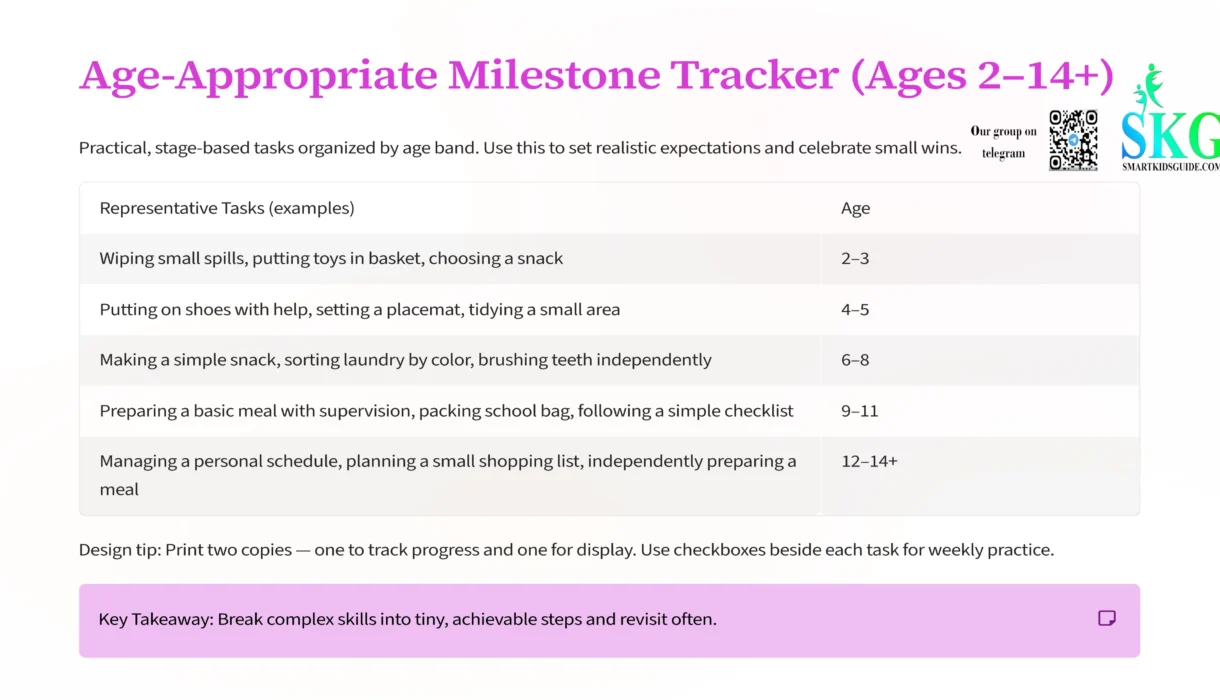
The short answer: Earlier than you think.
Children as young as 2 years old are developmentally ready to begin contributing to household tasks — not because it saves you time (it absolutely won’t), but because the habit of contribution is most naturally formed when children are at their most imitative. Toddlers want to do what you’re doing. That window is genuinely precious, and most of us accidentally close it by telling them they’re too little.
Here’s a rough framework by age:
Age | Realistic Tasks |
2–3 | Put toys in a bin, wipe up spills with a cloth, carry light groceries |
4–5 | Set the table, feed a pet, water plants, match socks |
6–7 | Pack their own school bag, make a simple breakfast, sort laundry |
8–10 | Load the dishwasher, vacuum a room, prepare a basic meal with guidance |
11–13 | Do their own laundry, cook simple meals independently, manage a weekly task list |
14+ | Handle most household tasks, manage their own schedule, take on larger responsibilities |
Two important notes on this chart:
First, these are starting points, not standards. A 9-year-old who’s never been given household responsibility won’t slot immediately into the 9-year-old column — start where they are, not where the chart says they should be.
Second, the goal at every age is the same: contribution, not perfection. A 4-year-old who sets a slightly lopsided table has done something genuinely valuable. Treat it that way.
Q: My child is capable of doing things independently but flat-out refuses. What do I do?
This is probably the most common question parents ask — and the most misunderstood.
When a capable child refuses an independent task, the instinct is to interpret it as defiance or manipulation. Sometimes it is. But far more often, what looks like refusal is actually something else entirely: fear dressed up as stubbornness.
Children who have been heavily assisted for a long time often develop a quiet but persistent belief that they can’t do things without help — even when the evidence suggests otherwise. They’ve learned, through no fault of their own, that struggle is a signal to wait for rescue rather than a cue to try harder. Asking them to suddenly operate independently doesn’t feel like freedom. It feels like abandonment.
The most effective response is not to push harder, but to reduce the size of the ask.
Instead of: “Go pack your bag by yourself.” Try: “Can you put your water bottle in your bag? I’ll get the rest.”
You’re not backing down. You’re scaffolding — finding the entry point where success is possible, then building outward from there. Resistance shrinks when the task feels survivable.
One more tool worth keeping in your back pocket: limited choices.
Rather than presenting independence as a demand, present it as an option within a structure they still feel some control over:
“Do you want to clear the plates now, or after we read one chapter?” “Do you want to make your bed before or after breakfast?”
The outcome you want still happens. But they’ve chosen how — and that small degree of agency makes a significant psychological difference. You’re working with their need for autonomy rather than against it.
Q: How do I handle it when my child tries and fails — badly?
With less commentary than you think is necessary, and more composure than you think you’re capable of.
Here’s the reality: how you respond to your child’s failures is one of the most formative things you will ever do as a parent. Not what you say when they succeed — what you do when they fall short.
Children are watching for information, not just comfort. When they fail at something and look at your face, they’re asking a silent question: “Is this catastrophic? Am I catastrophic?” Your response answers that question far more loudly than your words do.
A few principles for navigating failure well:
Regulate yourself first. If a spilled glass or a badly done chore genuinely triggers a stress response in you — and for many of us, it does — that’s worth noticing. Your child cannot learn that mistakes are survivable if your reaction suggests they aren’t. Take a breath before you speak. This is not optional.
Separate the child from the outcome. “That didn’t go the way we hoped — what do you think happened?” is a fundamentally different message than “Why did you do it like that?” One opens a conversation. The other opens a wound.
Let the recovery be theirs. Resist the impulse to swoop in and fix what went wrong. Ask what they think the next step is. Let them be part of the solution. The cleanup after the failure is often where the most important learning happens — not in the failure itself.
Normalize imperfection explicitly. Say out loud, regularly and casually, that you make mistakes too. That things go wrong. That wrong is not the same as ruined. Children who grow up in homes where imperfection is treated as information rather than indictment develop a relationship with failure that serves them for the rest of their lives.

Q: What if I've been doing everything for my child for years? Is it too late to change?
No. But it will be uncomfortable — for both of you — and that discomfort is worth naming upfront so you’re not caught off guard by it.
When you begin pulling back after years of high involvement, your child’s behavior will often get worse before it gets better. Expect more resistance, more frustration, possibly more meltdowns. This is not a sign that you’re doing it wrong. It’s a sign that the system is changing, and any system — including a family — resists change before it adapts to it.
A few things that help:
Start small and start private. Choose one low-stakes task in a calm moment, not during a rushed morning or an already stressful situation. Early wins build momentum.
Name the shift explicitly with older children. For kids over 7 or 8, a brief, honest conversation goes a long way: “I’ve realized I’ve been doing some things for you that I think you’re ready to handle yourself. I’m going to start letting you take the lead on some stuff — not because I don’t want to help, but because I think you’re more capable than I’ve been giving you credit for.” That reframe — capability, not withdrawal — changes the emotional texture of the whole transition.
Be consistent. The single fastest way to undo progress is to hold firm for three days and then cave on the fourth because you’re tired. Your child will learn, very quickly, that persistence pays off. If you commit to the shift, commit to it on the hard days too — especially on the hard days.
Give yourself grace. You will jump in when you shouldn’t. You will clean up the mess before they get a chance to. You will answer the question they could have figured out. That’s not failure — that’s Tuesday. Notice it, course-correct, and keep going.
Q: My child's teacher says they're struggling to work independently at school. What can I do at home to help?
The gap between school independence and home independence is one of the most consistent patterns child development specialists see — and it almost always flows in the same direction. Children who are heavily supported at home frequently struggle to self-direct in classroom environments, because the skills required — initiating a task without being told, managing frustration without immediate help, persisting through confusion — simply haven’t been practiced.
The most direct thing you can do is create low-stakes independence practice at home, daily and consistently. Not homework — that carries too much emotional weight for most children. Start with physical tasks: getting dressed without reminders, preparing their own after-school snack, deciding how to spend thirty minutes of free time without input from you.
These tasks build the same executive function muscles that school independence requires — initiation, self-monitoring, flexible thinking — in an environment where the stakes are low enough that struggle feels safe.
Also worth considering: talk to your child about the classroom experience directly. Not to problem-solve, but to understand. Ask them what the hard part is. Ask what it feels like when they get stuck and the teacher isn’t right there. Their answer will tell you more than any assessment report, and the conversation itself — being genuinely curious about their inner experience — builds the kind of relationship where they’ll come to you when it matters most.
Pro Tip: The 10-Second Rule
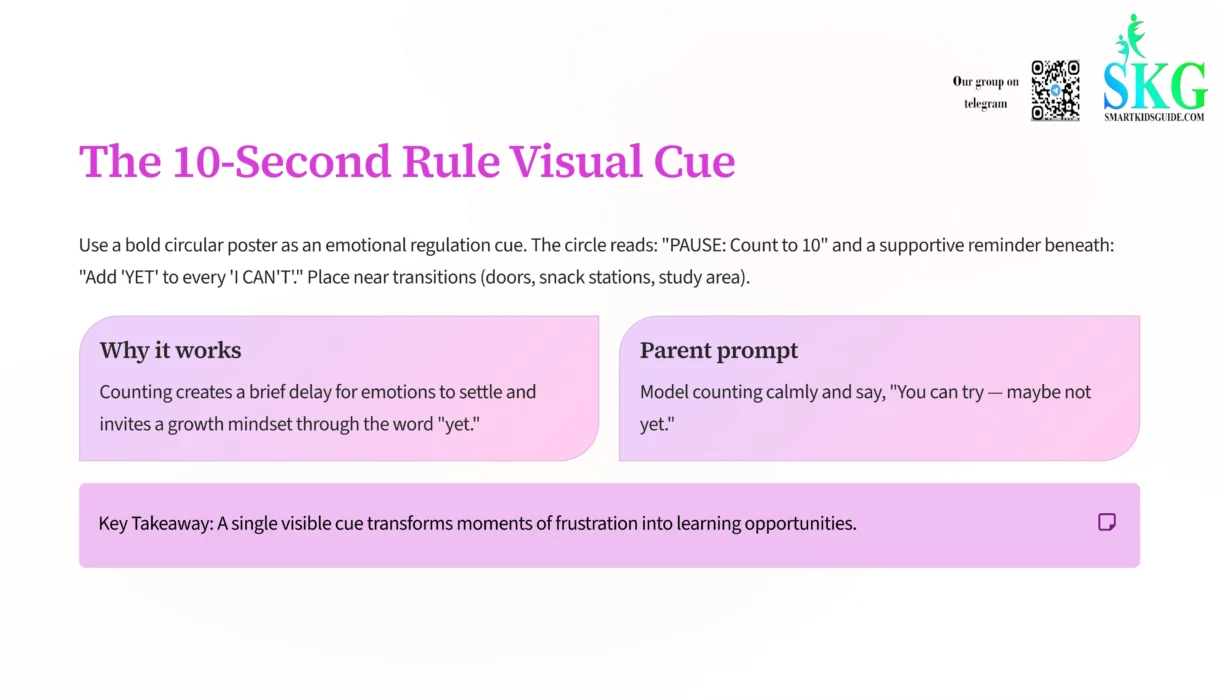
Before you step in to help your child with anything — a zipper, a math problem, a social conflict — count to ten silently. Not as a delay tactic, but as a genuine pause that gives their brain time to engage with the problem before yours takes it over. You’ll be surprised how often, at count seven or eight, they figure it out themselves. And when they do, say nothing. Let the win be theirs, uncomplicated by your commentary.
Pro Tip: Reframe "I Can't" in Real Time
When your child says “I can’t do this,” resist the urge to either agree or argue. Instead, add one word: “You can’t do this yet.” It sounds almost absurdly simple, but that single word — yet — signals that incompetence is temporary. It’s the linguistic foundation of a growth mindset, and children who hear it regularly begin to use it themselves. Which means they begin to believe it themselves.
Stage 5: The 10 Proven Strategies — The Complete Roadmap

From Knowing to Doing: 10 Strategies That Actually Work
Reading about independence is one thing. Building it, day after day, inside a real household with real children who have real bad days — that’s something else entirely. The scaffolding method gives you the framework. These ten strategies give you the daily tools.
Think of them not as a checklist to complete but as a menu to draw from — some will fit your family immediately, others will take time, and a few might only make sense six months from now when your child is in a different place. That’s fine. Take what’s useful. Come back for the rest.
Strategy 1: Build "Autonomy Zones" Into Your Home
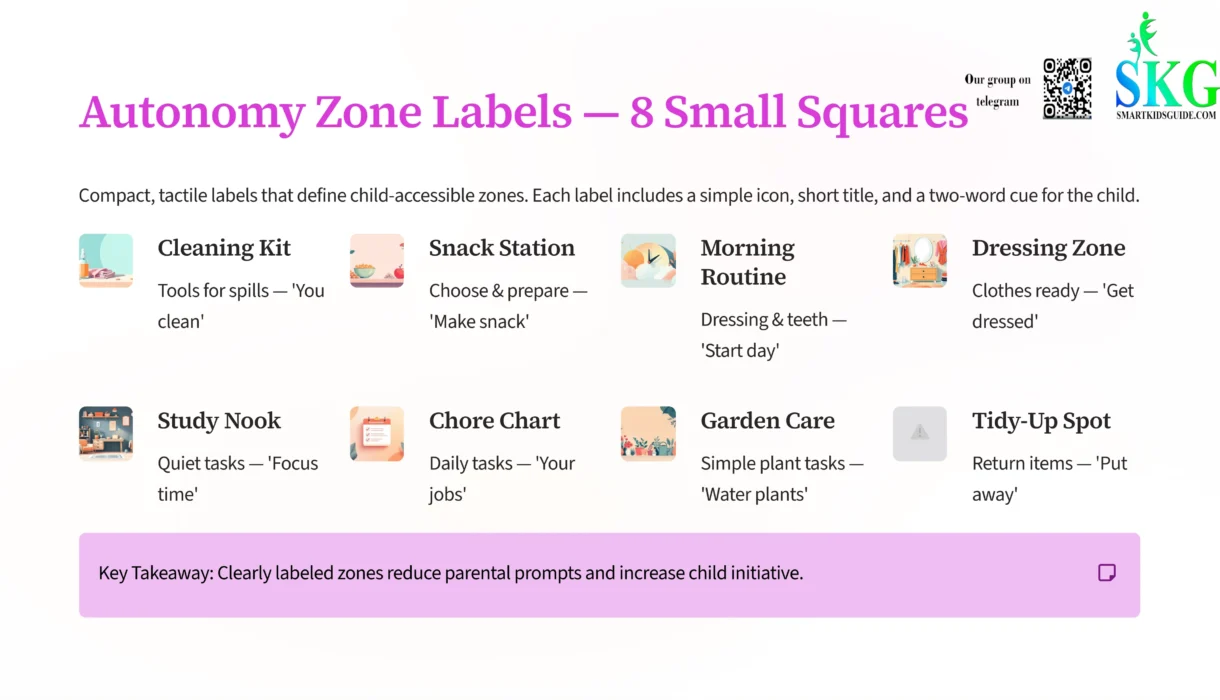
Before you can ask your child to be independent, you need to make independence physically possible.
Walk through your home right now and ask yourself: Can my child actually do this without me? Not theoretically — physically. Is the cereal on a shelf they can reach? Are their clothes organized in a way that makes choosing an outfit a real option rather than a chaotic excavation? Is their school bag in a place where packing it independently makes logical sense?
Most homes are unconsciously designed around adult convenience, which means children require adult assistance to navigate them. Small structural changes can dramatically shift the dynamic:
- Lower one shelf in the pantry to child height for snacks and breakfast items
- Put a hook at their level by the front door for their own bag and jacket
- Create a dedicated “their stuff” drawer in the bathroom for toothbrush, comb, and anything else that’s part of their morning routine
- Keep a small cleaning kit — cloth, spray bottle with water, small dustpan — somewhere accessible so cleaning up after themselves isn’t a production
None of these are expensive. All of them send a quiet but consistent message: this space is set up for you to function in it. That message matters more than most parents realize.
Strategy 2: Use "Sportscasting" Instead of Instructing
When your child is struggling with something — a puzzle, a conflict with a sibling, a task that isn’t going well — most parents default to one of two responses: solve it or critique it. There’s a third option that works significantly better: narrate it.
Sportscasting, borrowed from the RIE parenting philosophy developed by Magda Gerber, means describing what you observe without judgment, evaluation, or solution:
“You’re trying to get that piece to fit and it keeps slipping.” “You’ve tried that three times now. You look frustrated.” “You and your sister both want the same book right now.”
That’s it. No advice follows. No fix. Just witnessing — out loud.
What this does is remarkable: it keeps the problem in the child’s hands while making them feel seen. It validates the struggle without rescuing them from it. And it creates a brief moment of external perspective that often gives children exactly what they need to find their own way through.
Try it the next time you feel the pull to intervene. Say what you see. Then stop talking. See what they do with the space.
Visual Example: Setting Up Your First Autonomy Zone
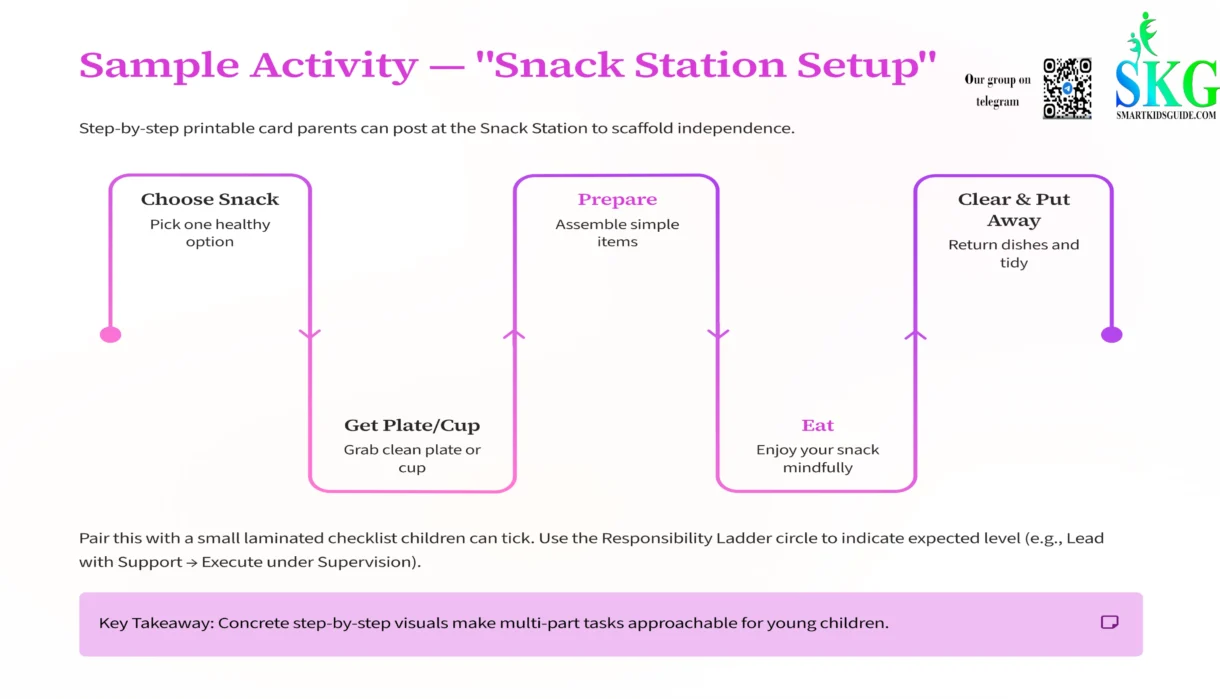
Strategy 3: Let Natural Consequences Do the Heavy Lifting
This is the strategy parents intellectually agree with and emotionally struggle to implement — because it requires you to watch your child experience something uncomfortable and do nothing about it.
Natural consequences are the outcomes that occur simply because of what happened, without parental engineering:
- They don’t bring a jacket. They’re cold.
- They don’t finish their dinner. They’re hungry later.
- They forget their homework. They face the teacher without it.
- They spend all their pocket money immediately. They have none left when they want something later.
The reason natural consequences work so powerfully is that they’re not coming from you. There’s no power struggle, no negotiation, no parental authority to push against. Reality is simply doing what reality does — and children, it turns out, are remarkably good at learning from reality when we stop insulating them from it.
The boundaries worth keeping in mind: Natural consequences that involve genuine physical danger, significant harm to others, or irreversible outcomes are not teaching tools — they’re just harm. The framework applies to the ordinary friction of daily life, not to situations where a child’s safety is at stake. Know the difference, and apply accordingly.
Strategy 4: Replace Praise With Process Acknowledgment
“You’re so smart.” “You’re so talented.” “You’re amazing at this.”
These feel like encouragement. Decades of research — most famously Carol Dweck’s work on growth mindset at Stanford — suggests they’re actually quietly undermining your child’s resilience.
When children are consistently praised for fixed traits — intelligence, talent, natural ability — they begin to see those traits as things they either have or don’t. Which means when they encounter something difficult, the difficulty reads as evidence that maybe they don’t have the trait after all. Rather than persist and risk that conclusion, many children quietly disengage. They stop trying hard things. They stay in the territory where they already know they’ll succeed.
The alternative isn’t to withhold encouragement. It’s to redirect it toward process:
Instead of: “You’re so smart.” Try: “You worked on that for a long time and didn’t give up — that’s what got you there.”
Instead of: “You’re a natural at this.” Try: “You’ve been practicing that for weeks. It’s really showing.”
Instead of: “Great job!” Try: “You figured that out yourself. How does that feel?”
The shift is subtle. The effect, over time, is not. Children who are praised for effort and strategy rather than ability develop a fundamentally different relationship with difficulty — one where hard things are opportunities rather than threats.
Strategy 5: Create a "Responsibility Ladder" Together
Independence imposed from above tends to generate resistance. Independence chosen — even within limits — tends to generate buy-in.
Sit down with your child, at a moment when no one is stressed or rushed, and build a responsibility ladder together: a visual, collaborative map of tasks they currently do, tasks they’re working toward, and tasks that represent where they’re headed.
The process matters as much as the product. When children have genuine input into what they’re taking on and when, several things happen simultaneously:
- They feel respected rather than managed
- They’re more likely to follow through because the commitment came from them
- They develop early practice in self-assessment — understanding what they can and can’t do yet
Keep the ladder visible. Refer back to it. Celebrate when something moves from “working toward” to “I’ve got this.” Let them be the one to move it.
For younger children, this can be as simple as a hand-drawn chart on the fridge. For older children, a shared notes app or a simple journal works well. The medium matters less than the conversation that builds it.
Strategy 6: Master the Art of the "Dumb Question"

One of the most effective tools in a parent’s arsenal is one that feels almost dishonest to use: pretending you don’t know the answer.
“Hmm, I’m not sure how to get the knot out of that. What do you think we could try?” “I can’t remember — where do we keep the extra paper towels? Can you figure it out?” “That’s a tricky math problem. What’s the first thing you’d do?”
You know the answers. That’s not the point. The point is that when you position yourself as uncertain, two things happen: first, your child’s brain shifts from passive reception to active problem-solving. Second, they get to experience being the one who figures something out — and that experience is addictive in the best possible way.
Use this sparingly enough that it doesn’t feel like a technique. But use it consistently enough that your child develops the habit of reaching inward for answers before reaching outward to you.
Strategy 7: Establish Routines That Run Themselves
One of the most underestimated sources of parental exhaustion isn’t the big dramatic moments — it’s the small, daily negotiations that accumulate into a kind of low-grade friction that never fully goes away. Did you brush your teeth? Did you pack your bag? Have you eaten anything this morning?
The antidote isn’t more reminding. It’s routine architecture — designing sequences that become automatic enough that your involvement is no longer required to trigger them.
The research on habit formation is clear on this: behaviors that are tied to consistent cues, in consistent environments, at consistent times, eventually stop requiring conscious decision-making. They just happen. The goal is to get your child’s morning routine — or homework routine, or bedtime routine — to that place of automaticity.
How to get there:
Build the routine with them, not for them. Ask what order makes sense to them. Ask what they find hardest to remember. Their input makes follow-through significantly more likely.
Use visual anchors for younger children. A simple picture chart on the bathroom mirror showing the morning sequence — brush teeth, wash face, get dressed, pack bag — removes you from the equation entirely. They check the chart. Not you.
Introduce a “routine object.” A specific object associated with the start of a routine — a particular playlist that signals homework time, a specific cup that means morning tasks begin — creates an environmental cue that triggers the behavior without a word from you.
Hold the line consistently for three weeks. Habit research consistently points to the three-week mark as the threshold where new routines begin to feel natural rather than effortful. The first week is hard. The second is negotiation. By the third, most children are initiating the routine themselves — not because you’ve won a battle, but because the behavior has become part of how they move through the day.
Strategy 8: Teach Decision-Making as a Skill, Not a Privilege
Most children are given decisions to make — what to wear, what to eat, what to watch — without ever being taught how to make them. Then we wonder why they freeze in front of open wardrobes or default to whatever requires the least effort.
Decision-making is a learnable skill. Like any skill, it improves with deliberate practice and clear scaffolding. Here’s a simple framework you can introduce gradually:
The 3-Question Check:
- What do I actually want here?
- What happens if I choose this?
- Is there anything I’m not thinking about?
Walk younger children through these questions out loud for low-stakes decisions. “You want to wear the shorts. It’s cold outside today — what do you think will happen? Is there anything else worth thinking about?” You’re not overriding their choice. You’re teaching them to think before they make it.
Over time, this internal checklist becomes automatic. And a child who has practiced deliberate decision-making in small moments is far better equipped to handle the larger decisions that arrive in adolescence — when the stakes are higher and the situations are more complex, and when you genuinely need them to be able to think clearly without you.
Strategy 9: Normalize Struggle — Out Loud and Regularly
Children develop their relationship with difficulty largely by watching how the adults around them handle it. If struggle in your household is treated as a problem to be solved as quickly as possible — by you, for them — then difficulty will feel threatening to your child. Something to escape, not move through.
The counter to this is straightforward but requires intentionality: talk about your own struggles openly.
Not in a way that burdens your child with adult problems they’re not equipped to carry. But in the ordinary, everyday way that communicates that hard things are a normal part of being a person:
“I’ve been trying to figure out this project at work and I keep getting stuck. It’s frustrating, but I’m going to keep at it.” “I burned the dinner. I’m going to try a different approach next time.” “I said something to a friend today that didn’t come out the way I meant it. I need to think about how to fix that.”
These small moments of witnessed struggle — and witnessed recovery — do more to build your child’s resilience than almost any direct instruction. They see that you fail. They see that you don’t fall apart. They see that you try again. That’s the curriculum that matters most.
Strategy 10: Celebrate the Process of Becoming
The final strategy isn’t a technique. It’s an orientation — a fundamental shift in what you choose to notice and name in your child.
Most parental attention flows toward outcomes: the grade, the performance, the finished product, the clean room. Children learn, quickly and accurately, that outcomes are what matter. And when outcomes are uncertain — which they always are — the risk of trying feels high.
What shifts this is deliberate, consistent attention to the process of becoming:
- “I noticed you kept working on that even when it got hard.”
- “You handled that disappointment really well.”
- “A few months ago, that would have been really difficult for you. Look at you now.”
- “You didn’t get the result you wanted, but you showed up and tried your best. That’s what I’m proud of.”
This isn’t toxic positivity. It’s not telling them the loss was actually a win or that the bad grade doesn’t matter. It’s holding two things simultaneously: honest acknowledgment of the outcome, and genuine recognition of who they’re becoming in the process of pursuing it.
Children who are seen this way — who feel that their effort, their persistence, their character are what the important people in their life are paying attention to — develop a relationship with themselves that no outcome can fully shake. They know who they are independent of whether they won or lost, succeeded or failed, got it right or got it wrong.
That’s not just good parenting. That’s a gift that lasts a lifetime.
Putting It All Together: Your First Week
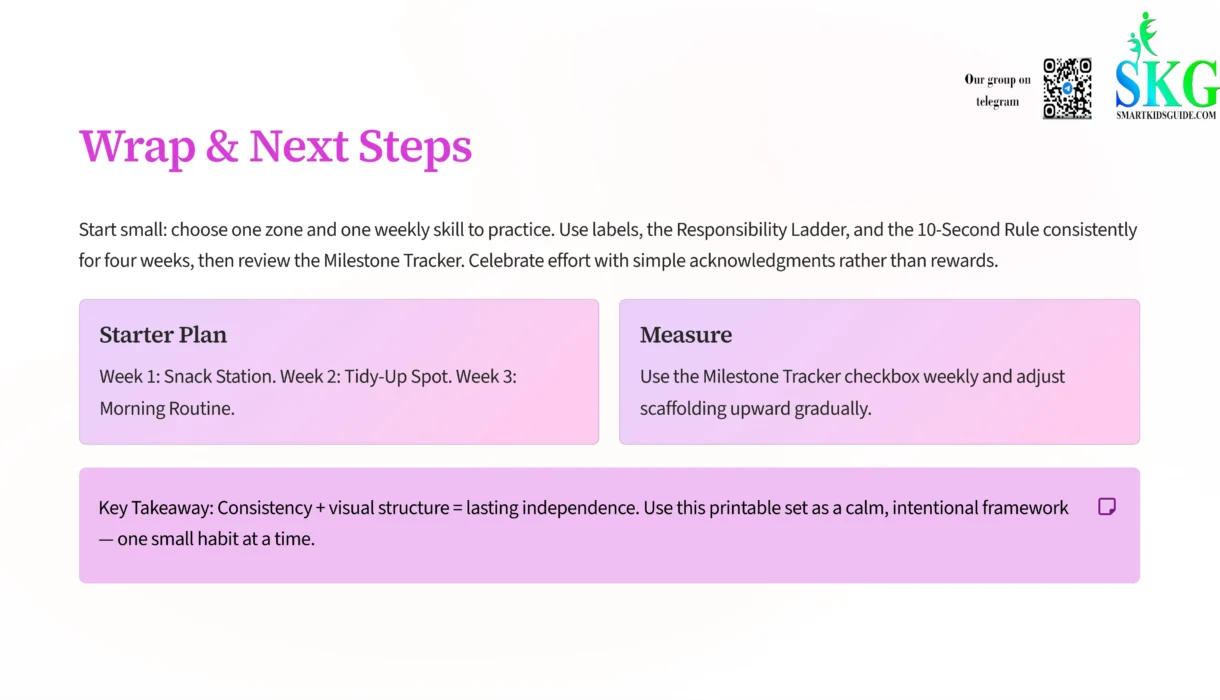
Don’t try to implement all ten strategies at once. Choose one. Apply it consistently for seven days. Notice what shifts — in your child, and in yourself. Then add another.
Independence isn’t built in a weekend. It’s built in the ordinary moments of ordinary days, accumulated over months and years, by parents who decided that the mess was worth it — because what grows out of the mess is worth everything.
Conclusion: Raising Capable Kids Starts With Letting Go (A Little)
H2: Conclusion: Raising Capable Kids Starts With Letting Go (A Little)
If there’s one truth to hold onto, it’s this: independence isn’t something you teach once—it’s something you build daily, moment by moment, choice by choice.
It’s in the pause before you step in.
It’s in the deep breath you take when the milk spills—again.
It’s in trusting that your child is more capable than their frustration suggests.
Raising independent and responsible kids doesn’t mean raising perfect kids. It means raising resilient, confident, and self-aware humans who know how to navigate life—even when things get messy.
Yes, it will take longer.
Yes, it will test your patience.
But every small moment of “letting them try” is an investment in who they become.
And one day, without even realizing it, you’ll look up and see a child who no longer waits to be told what to do…
…but steps forward and does it on their own.
"Stop Rescuing, Start Empowering!"
"Join our community and get your FREE Independence Roadmap Bundle (10-Page PDF). Includes chore charts, autonomy labels, and a 4-week starter plan to raise responsible kids."
Ready to Take the Next Step? (CTA)
If this guide resonated with you, don’t stop here—this is just the beginning of your parenting transformation.
👉 Start today with ONE small shift:
Pick a task you usually do for your child… and let them try it themselves.
👉 Want more practical, real-life parenting strategies?
Explore more guides on building confident, emotionally strong kids on your journey at smartkidsguide.com.
👉 Join our community of intentional parents
Get weekly tips, science-backed strategies, and real-life solutions delivered straight to your inbox—because raising great kids shouldn’t feel overwhelming.
💡 Remember: You’re not just raising a child…
You’re raising a future adult.
And it all starts today.